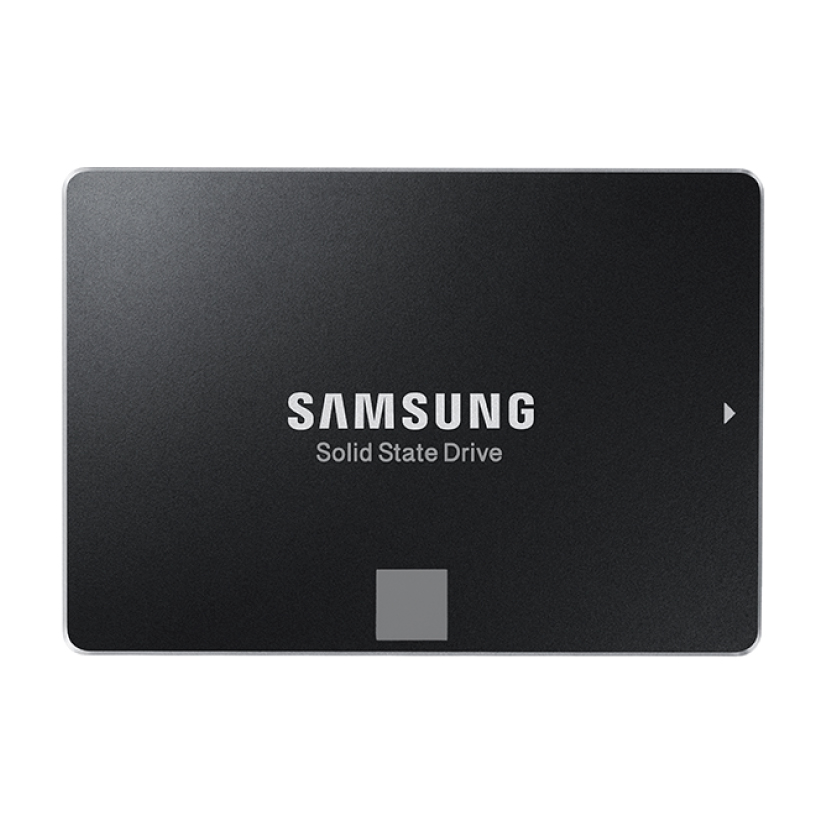
The Samsung SSD 850 EVO powered by Samsung V-NAND Technology is optimized for everyday computing performance and is ideal for desktop or ultra-slim mobile computing. 3D V-NAND technology Samsung's innovative 3D V-NAND flash memory architecture breaks through density, performance, and endurance limitations of today's conventional planar NAND architecture. Samsung 3D V-NAND stacks 32 cell layers vertically resulting in higher density and better performance utilizing a smaller footprint. Incredible read/write speeds Achieve incredible read/write performance to maximize your everyday computing experience with Samsung's TurboWrite technology. You can obtain up to 1.9x faster performance than the Samsung 840 EVO. The 850 EVO delivers excellent performance in sequential read (540MB/s) and write (520MB/s) speeds. Plus, gain optimized random performance in all QD for better real-world performance.
The Samsung SSD 850 EVO powered by Samsung V-NAND Technology is optimized for everyday computing performance and is ideal for desktop or ultra-slim mobile computing. 3D V-NAND technology Samsung's innovative 3D V-NAND flash memory architecture breaks through density, performance, and endurance limitations of today's conventional planar NAND architecture. Samsung 3D V-NAND stacks 32 cell layers vertically resulting in higher density and better performance utilizing a smaller footprint. Incredible read/write speeds Achieve incredible read/write performance to maximize your everyday computing experience with Samsung's TurboWrite technology. You can obtain up to 1.9x faster performance than the Samsung 840 EVO. The 850 EVO delivers excellent performance in sequential read (540MB/s) and write (520MB/s) speeds. Plus, gain optimized random performance in all QD for better real-world performance.
The Samsung SSD 850 EVO powered by Samsung V-NAND Technology is optimized for everyday computing performance and is ideal for desktop or ultra-slim mobile computing. 3D V-NAND technology Samsung's innovative 3D V-NAND flash memory architecture breaks through density, performance, and endurance limitations of today's conventional planar NAND architecture. Samsung 3D V-NAND stacks 32 cell layers vertically resulting in higher density and better performance utilizing a smaller footprint. Incredible read/write speeds Achieve incredible read/write performance to maximize your everyday computing experience with Samsung's TurboWrite technology. You can obtain up to 1.9x faster performance than the Samsung 840 EVO. The 850 EVO delivers excellent performance in sequential read (540MB/s) and write (520MB/s) speeds. Plus, gain optimized random performance in all QD for better real-world performance.
The Samsung SSD 850 EVO powered by Samsung V-NAND Technology is optimized for everyday computing performance and is ideal for desktop or ultra-slim mobile computing. 3D V-NAND technology Samsung's innovative 3D V-NAND flash memory architecture breaks through density, performance, and endurance limitations of today's conventional planar NAND architecture. Samsung 3D V-NAND stacks 32 cell layers vertically resulting in higher density and better performance utilizing a smaller footprint. Incredible read/write speeds Achieve incredible read/write performance to maximize your everyday computing experience with Samsung's TurboWrite technology. You can obtain up to 1.9x faster performance than the Samsung 840 EVO. The 850 EVO delivers excellent performance in sequential read (540MB/s) and write (520MB/s) speeds. Plus, gain optimized random performance in all QD for better real-world performance.
Last updated at 07/05/2026 17:21:06
Samsung 850 Evo 4tb Sataiii 2.5in Internal Ssd Mz-75e4t0
Free delivery
Affiliate Disclosure: We may receive a small commission for purchases made through this link at no extra cost to you. This helps support our site. Thank you!
Samsung MZ-75E4T0B/AM 850 EVO Series 4Tb 2.5-Inch Internal Solid State Drive
Free delivery between Tue – Sat
originally posted on ebay.com
This SSD (Solid State Drive) is an amazing piece of hardware and I recommend it in the fullest. If you are building a new PC this is a must have in the modern world as the benefits of SSD vs. HDD (Hard Disk Drive) are exponential by comparison. To put it in a nutshell, HDD's were obsoleted by the technology of an SSD and the difference is in how they store and access data. *end of nutshell* A HDD contains a circular plate (the Hard Disk) that serves as the medium for your data to be stored. The data is read by a little header (much like a CD player) and it is read one file at a time until all files has been found or whatever program you are tying to run (no multitasking). The hard disk has many different locations to store the data in and the locations have finite ... MoreThis SSD (Solid State Drive) is an amazing piece of hardware and I recommend it in the fullest. If you are building a new PC this is a must have in the modern world as the benefits of SSD vs. HDD (Hard Disk Drive) are exponential by comparison. To put it in a nutshell, HDD's were obsoleted by the technology of an SSD and the difference is in how they store and access data. *end of nutshell* A HDD contains a circular plate (the Hard Disk) that serves as the medium for your data to be stored. The data is read by a little header (much like a CD player) and it is read one file at a time until all files has been found or whatever program you are tying to run (no multitasking). The hard disk has many different locations to store the data in and the locations have finite space available to them. So if you fill the capacity of one area with a program it will have to store the rest of the program in a different area of the disk. This can become convoluted with time. The hard disk has to spin in order for the header to read the data. When your data is spread so thin that the header has to hit multiple locations in your hard disk to compile the data for one program you can begin to notice the issue with HDD's. When these things happen a lot you begin to have noticeable hits to your system performance. And this is why disk defragmenting is an essential part of PC maintenance when using an HDD. Defragmenting your disk would literally find files that belonged together and try and order them as closely and neatly as possible and this would help system performance. With SSD's these things are no longer the standard fare. The exact workings of an SSD I have yet to fully research but I can tell you the fundamental differences. A SSD has no moving parts. It has no disks to spin. Unlike a HDD it can pull data from all locations of the SSD at the same time (yes multitasking) to gather the files for your program. An SSD DOES NOT CARE how close your files are to each other or how neat the data is dispersed. This also means disk defragmenting is a thing of the past for a SSD (and could potentially mess up your SSD so DO NOT defragment these). Because of this the data transfer to and from a SSD is blazingly fast and will actually bottleneck (overload with information) older SATA interfaces. Do not worry though as the HDD you might be replacing with an SSD never came close to bottlenecking the SATA and you WILL get noticeable perform gains. Your computer will literally do everything faster with an SSD and is easily the best upgrade for an aging andslow PC and a literal must have for any new build. SSD's are in a laptop form factor as well so one literally fits all PC's, desktops and laptops. (There is a possibility of a PC case not supporting SSD mounting if it is sufficiently old). Price differences in SSD's come from the capacity of the drive and the ability of the data storage cells to write and re-write data before failing. The Samsung 850 EVO is of higher quality in this regard and that is the reason for the price premium when compared to the drives of competing manufacturers with similar or greater storage capacity. I happily recommend this product at its standard price and insist upon it when it goes on sale.
originally posted on newegg.com
I bought the Samsung SSD to be used as a test to determine if SSDs are now suitable for use in small business computers that store customer information. I have been a tech for over 40 years, which means that over 99% of everything I see is defective (customers do not call until something has gone wrong), and the memories of the early LCD displays and memory chips still cause me to be very cautious and to not trust any new product. I ran the tests on an MSI AM1m MB with an AMD 5350 2ghz APU and 16gb of ram. Boot Speed: On a Windows 8.1 PC, boot speed slowed from the original 12 seconds post-bios to the SSD speed of 24 seconds post-bios, likely caused by the need to load SSD software. Shut-down times remained reasonably similar. As a comparison, the SSD Windows 8.1 ... MoreI bought the Samsung SSD to be used as a test to determine if SSDs are now suitable for use in small business computers that store customer information. I have been a tech for over 40 years, which means that over 99% of everything I see is defective (customers do not call until something has gone wrong), and the memories of the early LCD displays and memory chips still cause me to be very cautious and to not trust any new product. I ran the tests on an MSI AM1m MB with an AMD 5350 2ghz APU and 16gb of ram. Boot Speed: On a Windows 8.1 PC, boot speed slowed from the original 12 seconds post-bios to the SSD speed of 24 seconds post-bios, likely caused by the need to load SSD software. Shut-down times remained reasonably similar. As a comparison, the SSD Windows 8.1 boot time is similar to Windows XP SP3 loading on the same hardware with a SATA2 HDD. Boot and shut-down speeds are not important, but they do give an idea of what to expect. Program Speed: Prefetch is disabled in the SSD software, so MS office programs load much slower (about 1 to 3 seconds as compared to about half a second on a SATA3 HDD, and as compared to almost instant on an XP SATA2 HDD). Non-prefetched programs like browsers and Libre office are much faster (around 9 seconds on the SSD as compared to 20 seconds or more on a HDD). Generally, I did not have any 'wow' moments for the SSD's speed, but the SSD does make the PC noticeably faster over all. Security: The primary concern is that sensitive customer data must be permanently destroyed when a HDD/SSD fails, and the only way to destroy the data is by destroying the HDD/SSD itself. Regardless of warranty, if a SSD fails the first minute after installation, the SSD must be destroyed. Destroying a $50 1tb HDD is no big deal, but destroying a brand new $180 500g SDD is uncomfortable. My thoughts: The SSD is good for personal computers, and I am tempted to install another Samsung SSD on one of my other PCs. At present, until the prices become competitive to HDDs, I will still not recommend relatively expensive SSDs for my 'thrifty' business customers who must store sensitive customer information.
originally posted on ebay.com
Bought this to replace a failing hard drive. Worked like a charm. The included software migrated all the data from the old hard drive and a little repair from the original windows DVD and all was working great. I recommend this to anyone who has an aging laptop. Now if I can just get one for NvMe drives I'll be doing great.
| Platform | Internal |
| Capacity | 4TB |
| Formatted Capacity Type | IDEMA |
| Read Speed (MB/s) | 540 |
| Write Speed (MB/s) | 520 |
Samsung 850 Evo 4tb Sataiii 2.5in Internal Ssd Mz-75e4t0
Free delivery
Affiliate Disclosure: We may receive a small commission for purchases made through this link at no extra cost to you. This helps support our site. Thank you!
Samsung MZ-75E4T0B/AM 850 EVO Series 4Tb 2.5-Inch Internal Solid State Drive
Free delivery between Tue – Sat
This SSD (Solid State Drive) is an amazing piece of hardware and I recommend it in the fullest. If you are building a new PC this is a must have in the modern world as the benefits of SSD vs. HDD (Hard Disk Drive) are exponential by comparison. To put it in a nutshell, HDD's were obsoleted by the technology of an SSD and the difference is in how they store and access data. *end of nutshell* A HDD contains a circular plate (the Hard Disk) that serves as the medium for your data to be stored. The data is read by a little header (much like a CD player) and it is read one file at a time until all files has been found or whatever program you are tying to run (no multitasking). The hard disk has many different locations to store the data in and the locations have finite ... MoreThis SSD (Solid State Drive) is an amazing piece of hardware and I recommend it in the fullest. If you are building a new PC this is a must have in the modern world as the benefits of SSD vs. HDD (Hard Disk Drive) are exponential by comparison. To put it in a nutshell, HDD's were obsoleted by the technology of an SSD and the difference is in how they store and access data. *end of nutshell* A HDD contains a circular plate (the Hard Disk) that serves as the medium for your data to be stored. The data is read by a little header (much like a CD player) and it is read one file at a time until all files has been found or whatever program you are tying to run (no multitasking). The hard disk has many different locations to store the data in and the locations have finite space available to them. So if you fill the capacity of one area with a program it will have to store the rest of the program in a different area of the disk. This can become convoluted with time. The hard disk has to spin in order for the header to read the data. When your data is spread so thin that the header has to hit multiple locations in your hard disk to compile the data for one program you can begin to notice the issue with HDD's. When these things happen a lot you begin to have noticeable hits to your system performance. And this is why disk defragmenting is an essential part of PC maintenance when using an HDD. Defragmenting your disk would literally find files that belonged together and try and order them as closely and neatly as possible and this would help system performance. With SSD's these things are no longer the standard fare. The exact workings of an SSD I have yet to fully research but I can tell you the fundamental differences. A SSD has no moving parts. It has no disks to spin. Unlike a HDD it can pull data from all locations of the SSD at the same time (yes multitasking) to gather the files for your program. An SSD DOES NOT CARE how close your files are to each other or how neat the data is dispersed. This also means disk defragmenting is a thing of the past for a SSD (and could potentially mess up your SSD so DO NOT defragment these). Because of this the data transfer to and from a SSD is blazingly fast and will actually bottleneck (overload with information) older SATA interfaces. Do not worry though as the HDD you might be replacing with an SSD never came close to bottlenecking the SATA and you WILL get noticeable perform gains. Your computer will literally do everything faster with an SSD and is easily the best upgrade for an aging andslow PC and a literal must have for any new build. SSD's are in a laptop form factor as well so one literally fits all PC's, desktops and laptops. (There is a possibility of a PC case not supporting SSD mounting if it is sufficiently old). Price differences in SSD's come from the capacity of the drive and the ability of the data storage cells to write and re-write data before failing. The Samsung 850 EVO is of higher quality in this regard and that is the reason for the price premium when compared to the drives of competing manufacturers with similar or greater storage capacity. I happily recommend this product at its standard price and insist upon it when it goes on sale.
I bought the Samsung SSD to be used as a test to determine if SSDs are now suitable for use in small business computers that store customer information. I have been a tech for over 40 years, which means that over 99% of everything I see is defective (customers do not call until something has gone wrong), and the memories of the early LCD displays and memory chips still cause me to be very cautious and to not trust any new product. I ran the tests on an MSI AM1m MB with an AMD 5350 2ghz APU and 16gb of ram. Boot Speed: On a Windows 8.1 PC, boot speed slowed from the original 12 seconds post-bios to the SSD speed of 24 seconds post-bios, likely caused by the need to load SSD software. Shut-down times remained reasonably similar. As a comparison, the SSD Windows 8.1 ... MoreI bought the Samsung SSD to be used as a test to determine if SSDs are now suitable for use in small business computers that store customer information. I have been a tech for over 40 years, which means that over 99% of everything I see is defective (customers do not call until something has gone wrong), and the memories of the early LCD displays and memory chips still cause me to be very cautious and to not trust any new product. I ran the tests on an MSI AM1m MB with an AMD 5350 2ghz APU and 16gb of ram. Boot Speed: On a Windows 8.1 PC, boot speed slowed from the original 12 seconds post-bios to the SSD speed of 24 seconds post-bios, likely caused by the need to load SSD software. Shut-down times remained reasonably similar. As a comparison, the SSD Windows 8.1 boot time is similar to Windows XP SP3 loading on the same hardware with a SATA2 HDD. Boot and shut-down speeds are not important, but they do give an idea of what to expect. Program Speed: Prefetch is disabled in the SSD software, so MS office programs load much slower (about 1 to 3 seconds as compared to about half a second on a SATA3 HDD, and as compared to almost instant on an XP SATA2 HDD). Non-prefetched programs like browsers and Libre office are much faster (around 9 seconds on the SSD as compared to 20 seconds or more on a HDD). Generally, I did not have any 'wow' moments for the SSD's speed, but the SSD does make the PC noticeably faster over all. Security: The primary concern is that sensitive customer data must be permanently destroyed when a HDD/SSD fails, and the only way to destroy the data is by destroying the HDD/SSD itself. Regardless of warranty, if a SSD fails the first minute after installation, the SSD must be destroyed. Destroying a $50 1tb HDD is no big deal, but destroying a brand new $180 500g SDD is uncomfortable. My thoughts: The SSD is good for personal computers, and I am tempted to install another Samsung SSD on one of my other PCs. At present, until the prices become competitive to HDDs, I will still not recommend relatively expensive SSDs for my 'thrifty' business customers who must store sensitive customer information.
Bought this to replace a failing hard drive. Worked like a charm. The included software migrated all the data from the old hard drive and a little repair from the original windows DVD and all was working great. I recommend this to anyone who has an aging laptop. Now if I can just get one for NvMe drives I'll be doing great.
Think I got a bit caught out on this. I know Samsung is a great name and SSD is exciting rejuvenation for any PC, after I found the EVO drive only lasts half the life of the PRO version I felt I had much overpaid on the going rate for these drives when they are only rated to last five years. The PRO version of the same thing is ten years but not twice the price. Looking st it the other way round the EVO is a LOT more than half the price of the PRO version. I guess there's nothing wrong with it, no. It's not that. It's just five years disappears fast and my money goes with it. Be careful how you use SSD. Their lifetime is a bit like mileage on a car, except that when they get to the end of that stated lifetime (5 years for the SAMSUNG EVO SSD) your data is no longer ... MoreThink I got a bit caught out on this. I know Samsung is a great name and SSD is exciting rejuvenation for any PC, after I found the EVO drive only lasts half the life of the PRO version I felt I had much overpaid on the going rate for these drives when they are only rated to last five years. The PRO version of the same thing is ten years but not twice the price. Looking st it the other way round the EVO is a LOT more than half the price of the PRO version. I guess there's nothing wrong with it, no. It's not that. It's just five years disappears fast and my money goes with it. Be careful how you use SSD. Their lifetime is a bit like mileage on a car, except that when they get to the end of that stated lifetime (5 years for the SAMSUNG EVO SSD) your data is no longer guaranteed to remain. Unlike a car or a traditional hard disk, which you can continue to use even beyond the manufacturer warranty, the warranty on the EVO SSD is just troubling to read that when it reaches that lifetime it does not accept any more data writing. This is like saying your car will no longer go into gear after the warranty has expired but you can still start the engine, use the heater, radio and music system but you will need a new car if you want to go anywhere. Technically it's still a car but for all practical purposes ceases to be one. If you buy a drive like the EVO my recommendation is NOT to use it for constantly writing fresh data like backups for example. Normal use is OK. Just set yourself a reminder in your phone to let you know when the time-up is getting near! I do believe SAMSUNG should make this limitation on the EVO SSD clear to consumers so they can make an informed choice. I'm not convinced that consumers are aware of this limitation and therefore I do not believe they buy this completely informed of the lifetime limitation in the EVO SSD.. I photographed the back of the box so you can read what's printed and notice there's no mention of the limited life or what happens when that time is reached. All you get is the positive stuff including five-year warranty.
I bought this for to replace a WD 1.5TB black HDD used to hold games. The reason behind moving my game storage from a HDD to an SSD was to decrease game load times. The 2nd reason was 1TB SSD’s are finally hitting a good price point. This review is late in coming I have owned this SSD for 2 years now. I ran CrysalDiskMark to perform the testing. Do to the speed of the drive I was not able to test its potential “real” data transfer speed. (as a note to the speed tests I am not sure why the newer 850 is slower than my older one) Samsung 850 EVO 1TB: Read 403 MB/s, Write 411 MB/s (2017 model firmware EMT03B6Q) For Comparison Samsung 860 Evo 256GB : Read 542 MB/s, Write 509 MB/s (new drive in another computer) Samsung 850 Pro 512GB: Read 553 MB/s, Write 502 MB/s (2014 ... MoreI bought this for to replace a WD 1.5TB black HDD used to hold games. The reason behind moving my game storage from a HDD to an SSD was to decrease game load times. The 2nd reason was 1TB SSD’s are finally hitting a good price point. This review is late in coming I have owned this SSD for 2 years now. I ran CrysalDiskMark to perform the testing. Do to the speed of the drive I was not able to test its potential “real” data transfer speed. (as a note to the speed tests I am not sure why the newer 850 is slower than my older one) Samsung 850 EVO 1TB: Read 403 MB/s, Write 411 MB/s (2017 model firmware EMT03B6Q) For Comparison Samsung 860 Evo 256GB : Read 542 MB/s, Write 509 MB/s (new drive in another computer) Samsung 850 Pro 512GB: Read 553 MB/s, Write 502 MB/s (2014 model firmware EXM04B6Q) Samsung 850 Evo 1TB: Read 555 MB/s, Write 508 MB/s (2014 Model firmware EMT02B6Q) WD Black NVMe 500GB: Read 3414 MB/s, Write 2543 MB/s WD Red 3TB WDEFRX: Read 135 MB/s, Write 128 MB/s Even though the newer drive is “slow” I am still happy with its performance. It is very close to the max speed of a sata III (6gbps) interface. I have the 2 Evo’s for my game libraries and the Pro for my OS. The EVO series in has a shorter expected life than the Pro series (fewer writes) which is why I am using it for my game library. I expect to only install and not uninstall games regularly, while the OS drives tend to do more writes. I am also using a standard HDD the WD Red 3tb for my mass storage like pictures, docs, and music.
My old Toshiba Satellite A205-S5825 boot time is now +4x faster than with my old internal system hard drive. Instead of the CPU waiting for the hard drive, this SSD is now waiting for the CPU. Very easy to clone the operating system, programs & personal data files to this SSD from my hard drive, I merely downloaded & installed the free SSD Data Migration software from the Samsung site, hooked up the $5 USB-to-SATA cable between the laptop and the SSD, executed the Samsung program, and cloned the 100gb of OS, installed programs, & personal files from my old intenal hard drive to the SSD with 3 clicks of my mouse. 1 hour and 30 minutes later (about 18mb/sec transfer rate due to my 5500rpm hard drive), my new 250gb was ready to swap out with my old laptop system drive. ... MoreMy old Toshiba Satellite A205-S5825 boot time is now +4x faster than with my old internal system hard drive. Instead of the CPU waiting for the hard drive, this SSD is now waiting for the CPU. Very easy to clone the operating system, programs & personal data files to this SSD from my hard drive, I merely downloaded & installed the free SSD Data Migration software from the Samsung site, hooked up the $5 USB-to-SATA cable between the laptop and the SSD, executed the Samsung program, and cloned the 100gb of OS, installed programs, & personal files from my old intenal hard drive to the SSD with 3 clicks of my mouse. 1 hour and 30 minutes later (about 18mb/sec transfer rate due to my 5500rpm hard drive), my new 250gb was ready to swap out with my old laptop system drive. 10 minutes to physically swap the drives and power on, and I was up and running without any issues. (My old internal hard drive is now retired as a "just-in-case" back-up in the event my laptop is stolen or destroyed). WIth the best warranty in the industry (5-years), I am not to worried on the longevity of this 850 EVO SSD, but I like to be prepared for any contingency. The 850 EVO SSD is currently the fastest and highest rated SSD in its class, and cost is less than $20 more than the basic bargain basement brands.Additionally, what I'm not going to miss is hearing that ever-present muted ticking of the heads in the old hard drive and the spin-up/down of that hard drive motor depleting the battery at an alarming rate. With this SSD, I also realize over 20% more battery time between recharges! If you want to stretch the lifespan of an older reliable laptop (I hate having to reinstall and replace some ever-more-expensive software in a laptop upgrade to fit the new operating system, when your older laptop is doing just fine, but a bit slow), or optimizing your new laptop, a Samsung 850 EVO drive is an easy "viagra" upgrade for less than $100 (I bought my 250gb for less than $70 with free shipping)! When sizing your SSD, I do, recommend at least doubling the capacity of the old hard drive you are replacing, as you should still have plenty of storage when you re-clone the SSD from the internal drive of your next laptop upgrade, when you finally do make the switch.
Thanks to Xboxes shipped with this diminutive capacity drive which many have upgraded resulting in a steady stream of these drives being available from CeX I now have three of these drives and may buy more going forward. Korg support for arguably the best music workstation of all time has now ended although unlimited reauthorisations are now possible. So I decided to mod my Kronos to give external access to the device's system hard drive connectors. Drive one has all the original samples, programs and combis et cetera, and I immediately noticed booting up with these drives is also much faster. Changing over to the second drive I have the same but with a load of sound expansions on it, the same for the third.In each case the the original material is overwritten to ... MoreThanks to Xboxes shipped with this diminutive capacity drive which many have upgraded resulting in a steady stream of these drives being available from CeX I now have three of these drives and may buy more going forward. Korg support for arguably the best music workstation of all time has now ended although unlimited reauthorisations are now possible. So I decided to mod my Kronos to give external access to the device's system hard drive connectors. Drive one has all the original samples, programs and combis et cetera, and I immediately noticed booting up with these drives is also much faster. Changing over to the second drive I have the same but with a load of sound expansions on it, the same for the third.In each case the the original material is overwritten to make way for the expansions. Why not just get a larger drive instead? You can't do that with this instrument as the CDs used to install everything lack the ability to enlarge the partition that contains the OS and data, and a lot of its capacity would thus be wasted or might even lead to installation failure which was the case when I tried a 250GB version of the drive under discussion.The photo shows my initial modification. The instrument itself is not gigged or toured so it works fine like this for now, but I aim to improve on it going forward. You just need to very carefully redirect the two existing leads to the internal hard drive back in the opposite direction and then securely re-fasten everything.For the more general buyer I would recommend these drives. However over time (years) storage capacity will reduce so, depending on your needs it might be better to buy the largest version of these drives that you can afford.
After trying the Crucial 1 TB SSD i've been sold on them ever since. Insanely fast compared to platter HD's and even hybrids. My quibble with the Crucial is it is SUPPOSED to be 1 tb capacity but only shows 698 GB capacity! 300 gb lost is not a minor thing...it might have been taken over by the reserve partition or something like that but, this irked me enough to want to try another brand. As always, installation has the possibility to be a headache but, the enclosed DVD that came with the drive, did all the work. I don't think the program cares what brand or type you use as source disk, there is no going to their site and entering some code just so you can download and use your own cloning program for your own disk, no codes to enter and nothing to download. Simple ... MoreAfter trying the Crucial 1 TB SSD i've been sold on them ever since. Insanely fast compared to platter HD's and even hybrids. My quibble with the Crucial is it is SUPPOSED to be 1 tb capacity but only shows 698 GB capacity! 300 gb lost is not a minor thing...it might have been taken over by the reserve partition or something like that but, this irked me enough to want to try another brand. As always, installation has the possibility to be a headache but, the enclosed DVD that came with the drive, did all the work. I don't think the program cares what brand or type you use as source disk, there is no going to their site and entering some code just so you can download and use your own cloning program for your own disk, no codes to enter and nothing to download. Simple install of the cloning program, then you tell it to clone your drive and the program does the rest. It will not shut off your computer automatically as the Crucial drive program does so you have to check the screen for the notice that tells you to shut off your computer now. I cloned using a Crucial solid state drive as source disk, and i timed it at a half hour start to finish. (I'd guess a platter type source drive will take longer but I don't really know). Anyway when it tells you shut off the computer, then restart to boot to your new drive and you are done. No muss, no fuss, easy. And the capacity of this Samsung is well over 900 GB (they say when they make the chips they can't pick exactly how big it will come out, the chips are tested and the ones close to the desired capacity are what go into the drive). Anyway, this solid state drive is well worth it - the speed of these has spoiled me, the same way cable internet spoiled you for modems forevermore after you used it...I don't even want to bother using any platter type drive now since the slower response would drive me mad. When I used a hybrid drive as my main hard drive, boot time was over 2.5 minutes...you know the kind, where you turn on the computer and then go shave or something while it comes on? Now with a solid state drive it's less then 30 seconds, doing a restart takes maybe 40 seconds. Once you go solid state, there's no going back...
500GB does not equal 500GB according to your computer. Allow me to explain: All storage devices are measured in bytes, but it's not the same byte that your OS recognizes - computers can only recognize a base-2 numbering system, whereas we use a base-10 system. The closest value to 1000 that can be reached in base-2 is 1024 (or 2^10), hence 1,024 bytes = 1 kilobyte 1,048,576 bytes (2^10*2^10 or 2^20bytes) = 1 Megabyte 1,073,741,824 bytes ((2^10)^3) or 2^30 bytes) = 1 Gigabyte What we consider 500 GB is actually 5*10^11 bytes, but a computer can only see it as 465.66 GB (5*10^11/2^30) thanks to this numbering system! So technically it's not the drive manufacturers who are ripping you off, it's a 17th Century German mathematician and his obsession with Chinese ... More500GB does not equal 500GB according to your computer. Allow me to explain: All storage devices are measured in bytes, but it's not the same byte that your OS recognizes - computers can only recognize a base-2 numbering system, whereas we use a base-10 system. The closest value to 1000 that can be reached in base-2 is 1024 (or 2^10), hence 1,024 bytes = 1 kilobyte 1,048,576 bytes (2^10*2^10 or 2^20bytes) = 1 Megabyte 1,073,741,824 bytes ((2^10)^3) or 2^30 bytes) = 1 Gigabyte What we consider 500 GB is actually 5*10^11 bytes, but a computer can only see it as 465.66 GB (5*10^11/2^30) thanks to this numbering system! So technically it's not the drive manufacturers who are ripping you off, it's a 17th Century German mathematician and his obsession with Chinese divination that's causing you to lose precious drive capacity. (It's also the industry' fault for standardizing human bytes over computer bytes) Samsung is one of the only manufacturers to design and build all of the components inside their SSDs, giving them a significant cost and development advantage as all aspects of their SSDs can be controlled in house. Only Toshiba and Intel have this top-down control over their SSD production, although they have used components from outside their company for lower-end consumer drives. The 850 EVO is a product of Samsung's industry advantage, being the first consumer SSD that combined the affordable TLC flash structure with vertical NAND (or V-NAND) density. In layman's term, Samsung can not only make cheaper flash memory, but they can cram more capacity in each package of flash memory, reducing the number or flash packages needed for certain capacities and further driving down costs. The 850 EVO comes in both 2TB and 4TB versions thanks to the benefits of vertical scaling in flash capacity increasing both the capacity of each flash die and the density of dies per package. They use the same number of flash packages as the 1TB 850 EVO, but are able to double or quadruple capacity thanks to this increase in number of dies and die capacity per package. This may soon affect prices of future 850 EVOs under 2TB. Right now, the 500GB Samsung 850 EVO uses 4 flash packages, with 8 dies per package, and a total capacity of 128 Gigabit (or 16 Gigabyte) per die. That's 32 dies of 16 Gigabyte each, or 512GB of total capacity. Approximately 12GB is left out for over-provisioning, so that's 500GB of usable storage (or 465GiB of "actual" storage). If Samsung chooses to trickle down these denser NAND packets, the next iteration of the 500GB 850 EVO will only have 2 flash packages with 16 dies per package and 16 GB per die (based on the 2TB EVO) or even a single flash package with 16 dies and 32GB per die (based on the 4TB EVO). Whether that will lead to a significant price drop is yet to be seen, since the denser die packages in the 2TB and 4TB EVOs are between 4 to 6 times the cost of the older EVOs' packages.
The Samsung EVO 850 is capable of providing a huge increase in performance providing your computer meets certain requirements. The computer motherboard must have available a high-speed interface connection known as SATA3. SATA3 has a maximum data transfer rate of 600 megabytes per-second, barely more than the rated 525 megabytes per-second speed of the EVO 850. SATA1 or SATA2 are slower at transferring data than the EVO 850 and therefore will be incapable of providing the maximum performance the drive can deliver. If your computer is more than 6 years old, it may not have a SATA3 port. My 4-year-old DELL XPS 8500 has only 1 SATA3 port, the rest are SATA2. Your computer should also have a relatively fast processor and dual channel memory. So you see, the performance ... MoreThe Samsung EVO 850 is capable of providing a huge increase in performance providing your computer meets certain requirements. The computer motherboard must have available a high-speed interface connection known as SATA3. SATA3 has a maximum data transfer rate of 600 megabytes per-second, barely more than the rated 525 megabytes per-second speed of the EVO 850. SATA1 or SATA2 are slower at transferring data than the EVO 850 and therefore will be incapable of providing the maximum performance the drive can deliver. If your computer is more than 6 years old, it may not have a SATA3 port. My 4-year-old DELL XPS 8500 has only 1 SATA3 port, the rest are SATA2. Your computer should also have a relatively fast processor and dual channel memory. So you see, the performance gain might be disappointing in an old, low-powered computer. In my computer, the performance gain was enormous. However, I took the unusual step of performing a clean install of my operating system (Windows 8.1) directly to the EVO 850. I did this to ensure that nothing that could slow my system down was transferred from the old hard drive the EVO 850 was replacing. This step requires an enormous amount of work, however. It took me more than 8 hours to install Windows 8.1, 360 updates, and the 30 applications I use. One big advantage to this approach was that I was able to keep all my user files (more than 600 gigabytes worth) on the old mechanical hard drive. This was important to me as the EVO 850 has only 500 gigabytes of total storage. I then backed up all my user files to an inexpensive ($50) USB external hard drive. I now have speed and a complete data back-up for security for minimal cost. To give you an idea just how fast the EVO 850 is, boot times for the computer went from a little over 2 minutes to just 30 seconds until the desktop became visible. Much more importantly, the operating system loaded all my programs, completed the many background tasks my applications require, and was ready to get to work in only 15 SECONDS from the time the desktop appeared. With the old, mechanical hard drive, it took 15 MINUTES for the computer to be ready to work. Any application I launch loads in just a few seconds, more that twice as fast as the mechanical hard drive. I am now much more productive with my time spent at the computer. I also have peace of mind knowing that the EVO 850 is far less likely to fail than the mechanical hard drive. I highly recommend the EVO 850.
| Platform | Internal |
| Capacity | 4TB |
| Formatted Capacity Type | IDEMA |
| Read Speed (MB/s) | 540 |
| Write Speed (MB/s) | 520 |

