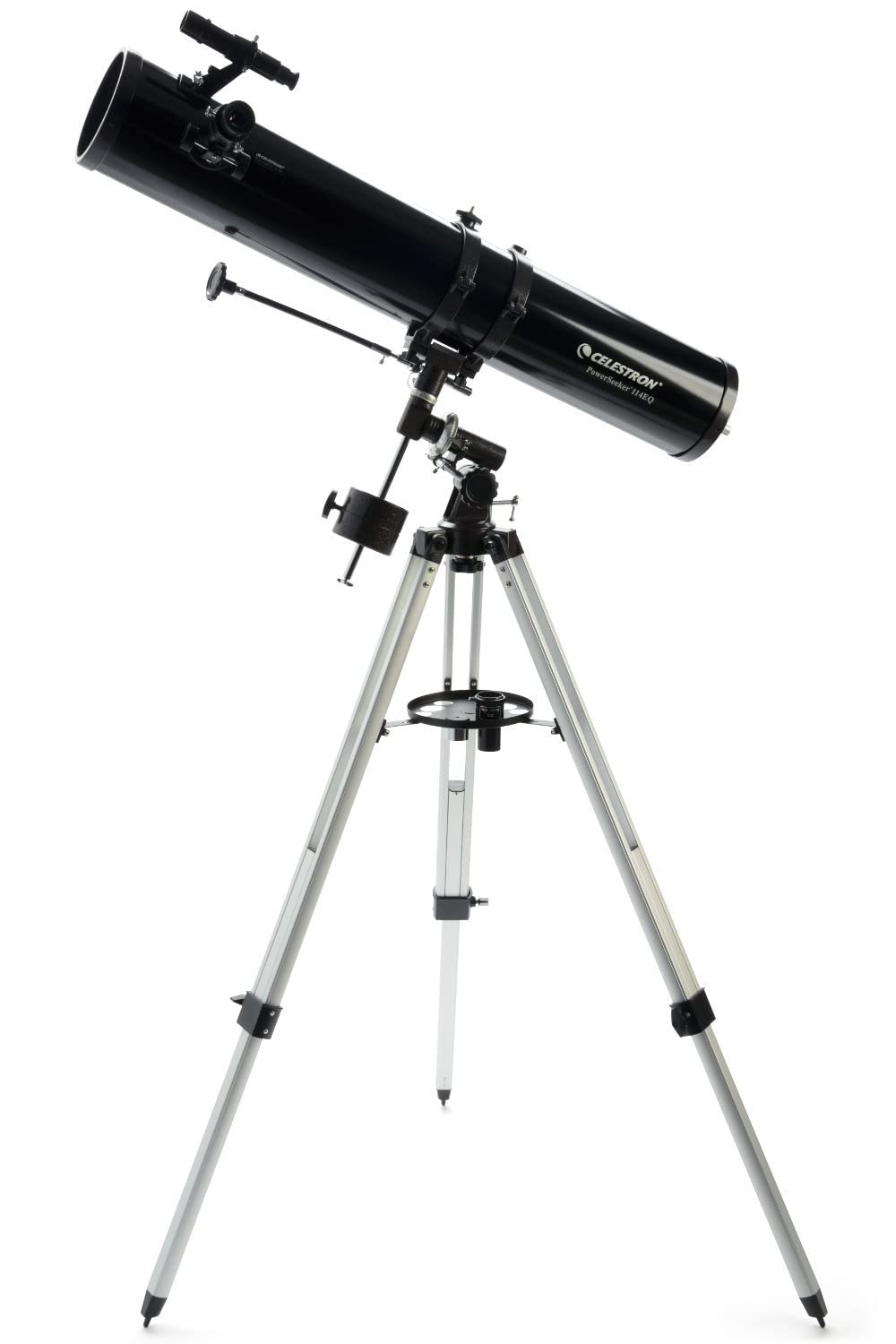
Discover our Solar System with the Celestron PowerSeeker 114EQ. You will be ready to observe in minutes thanks to the quick and easy no tool setup. The 114EQ provides bright, clear images of the Moon, planets, star clusters, and more for great night time viewing. The PowerSeeker mount comes with two slow motion control knobs that allow you to make fine pointing adjustments to the telescope in both Right Ascension and Declination axes, also referred to as RA and DEC. Accessories include a 20mm and 4mm eyepiece, a finderscope, and a barlow lens. The two eyepieces offer different magnifications for low and high powered views. The 3x Barlow lens triples the magnifying power of each eyepiece. Download the Celestron Starry Night Software and learn about the night sky, celestial objects, and how to plan your next observing session. Celestron Starry Night Software is the premier astronomy software package on the market, providing resources and knowledge to view our solar system and beyond.
Discover our Solar System with the Celestron PowerSeeker 114EQ. You will be ready to observe in minutes thanks to the quick and easy no tool setup. The 114EQ provides bright, clear images of the Moon, planets, star clusters, and more for great night time viewing. The PowerSeeker mount comes with two slow motion control knobs that allow you to make fine pointing adjustments to the telescope in both Right Ascension and Declination axes, also referred to as RA and DEC. Accessories include a 20mm and 4mm eyepiece, a finderscope, and a barlow lens. The two eyepieces offer different magnifications for low and high powered views. The 3x Barlow lens triples the magnifying power of each eyepiece. Download the Celestron Starry Night Software and learn about the night sky, celestial objects, and how to plan your next observing session. Celestron Starry Night Software is the premier astronomy software package on the market, providing resources and knowledge to view our solar system and beyond.
Discover our Solar System with the Celestron PowerSeeker 114EQ. You will be ready to observe in minutes thanks to the quick and easy no tool setup. The 114EQ provides bright, clear images of the Moon, planets, star clusters, and more for great night time viewing. The PowerSeeker mount comes with two slow motion control knobs that allow you to make fine pointing adjustments to the telescope in both Right Ascension and Declination axes, also referred to as RA and DEC. Accessories include a 20mm and 4mm eyepiece, a finderscope, and a barlow lens. The two eyepieces offer different magnifications for low and high powered views. The 3x Barlow lens triples the magnifying power of each eyepiece. Download the Celestron Starry Night Software and learn about the night sky, celestial objects, and how to plan your next observing session. Celestron Starry Night Software is the premier astronomy software package on the market, providing resources and knowledge to view our solar system and beyond.
Discover our Solar System with the Celestron PowerSeeker 114EQ. You will be ready to observe in minutes thanks to the quick and easy no tool setup. The 114EQ provides bright, clear images of the Moon, planets, star clusters, and more for great night time viewing. The PowerSeeker mount comes with two slow motion control knobs that allow you to make fine pointing adjustments to the telescope in both Right Ascension and Declination axes, also referred to as RA and DEC. Accessories include a 20mm and 4mm eyepiece, a finderscope, and a barlow lens. The two eyepieces offer different magnifications for low and high powered views. The 3x Barlow lens triples the magnifying power of each eyepiece. Download the Celestron Starry Night Software and learn about the night sky, celestial objects, and how to plan your next observing session. Celestron Starry Night Software is the premier astronomy software package on the market, providing resources and knowledge to view our solar system and beyond.
Last updated at 08/20/2026 12:27:13
Celestron 21045 Power Seeker Telescope, Reflector, Black
Affiliate Disclosure: We may receive a small commission for purchases made through this link at no extra cost to you. This helps support our site. Thank you!
Wholesale Celestron Astronomical Telescope PowerSeeker 114 EQ LargeAperture Professional Newtonian Reflector Deep pace High Magnification,1 Piece
Delivery $134.89
Celestron PowerSeeker 114EQ f/7.89 Newtonian Telescope
Affiliate Disclosure: We may receive a small commission for purchases made through this link at no extra cost to you. This helps support our site. Thank you!
Celestron Powerseeker 114eq Astronomical Telescope 21045 Complete Kit
Free delivery
Affiliate Disclosure: We may receive a small commission for purchases made through this link at no extra cost to you. This helps support our site. Thank you!
Celestron 21045 114mm Equatorial PowerSeeker EQ Telescope
Affiliate Disclosure: We may receive a small commission for purchases made through this link at no extra cost to you. This helps support our site. Thank you!
Presale Celestron Astronomical Powerseeker 114eq Telescope Withtripod
Free delivery
Affiliate Disclosure: We may receive a small commission for purchases made through this link at no extra cost to you. This helps support our site. Thank you!
Celestron Celestron PowerSeeker 114EQ Telescope
Celestron PowerSeeker 114EQ Telescope – 4.5" Reflector, Easy Setup
Delivery $1,408.64
Celestron Powerseeker 114EQ Telescope
Celestron PowerSeeker 114EQ Newtonian
Delivery $67.04
originally posted on celestron.com/
I had a beginner refractor scope on a standard mount, and it was a real pain to try an keep objects in the field of view, especially at higher magnification levels. Dang planet just spins too fast. So I was looking for an equatorial mount, that would let me more easily track objects and make observation more relaxing. Plus, I was also looking to get something that captured more light, so I could see fainter objects. This is about as inexpensive as equatorial-mounted scopes get. And this particular one had the largest aperture for light gathering. That said, it requires a little TLC. The mirrors need to be checked and aligned regularly (collimation). There are instructions in the manual for that. And, I upgraded to a metal finderscope mount, so I could set it and ... MoreI had a beginner refractor scope on a standard mount, and it was a real pain to try an keep objects in the field of view, especially at higher magnification levels. Dang planet just spins too fast. So I was looking for an equatorial mount, that would let me more easily track objects and make observation more relaxing. Plus, I was also looking to get something that captured more light, so I could see fainter objects. This is about as inexpensive as equatorial-mounted scopes get. And this particular one had the largest aperture for light gathering. That said, it requires a little TLC. The mirrors need to be checked and aligned regularly (collimation). There are instructions in the manual for that. And, I upgraded to a metal finderscope mount, so I could set it and forget it (instead of constantly resetting and fiddling with the cheap, flexible/slippery plastic mount that came with the scope).With exception of the finder mount, the scope worked pretty well out of the box. First thing I looked at was the moon, and it showed up with startling clarity, even using the 4mm eyepiece (I did not try the Barlow lens). Looking at smaller objects, like Venus, I could tell that collimation would help get things a little more crisp. Once you get the tube balanced in the mount, that's something you never have to change, unless you add cameras or other accessories to vary the weight. But it is a bit of a hassle at first. I found it was easier to fasten the rings loosely to the mount, then slide the tube in and gradually tighten things up. Then when you're balancing it, you have to loosen it to slide it either way and re-tighten. Awkward. The mount is pretty easy to set up. Once you level the tripod, you just set the angle of the mount to match your latitude (there's a scale on the side of the mount), and point it north. From there, you can use the slow-motion controllers to keep objects in the field of view quite easily. Big improvement over a standard scope mount. There are apps you can download to help you be more precise in aligning the mount, but I just set mine up roughly using a compass, and it worked pretty well for casual viewing. The tripod is disappointing and flimsy. I added some spring lockwashers to the top leg screws, to tighten it up a bit and keep the legs from flopping around. I also put an adhesive bubble level on the top of the tripod. The 20mm eyepiece has a prism in it that makes what you're seeing right-side-up. The 4mm eyepiece doesn't...everything will be upside down. This thing is not really very portable as-is. If you want to move around with it, I'd get a small gym bag for the tube and another long, narrow tripod bag for the tripod and mount (leaving the mount attached). And you'll have to find some way to carry the counterweight – it's 7.5 lbs. of broken toe/foot waiting to happen. Mostly, this seems ideal if you have a regular viewing area where you can mark the location of your tripod legs, and just carry it in and out each evening, leaving it set up inside. That's my situation, and I'm pretty satisfied with this. Overall, it's a good value that throws you quickly into the deep end thinking about and understanding how all this stuff overhead is moving around. Pretty cool.
originally posted on celestron.com/
I bought this scope to have a smaller and light weight reflector and it’s ok. It does fill the role I wanted and it would be ok for a beginner scope. After collimation the views were pretty clear and clean. I agree the the other reviewers the spotting scope is useless. It is very difficult to localize. I finally just gave up and I’ll try again sometime. Also the focuser is clearly designed for new observers. It functions but could be a lot better. Overall this is ok to get your feet wet but not the best.
originally posted on celestron.com/
The PowerSeeker 127eq is an OK scope for an experienced observer, but can be quite challenging for beginners. A much better choice would be the AstroMaster 130eq. Here's why:1: the PowerSeeker scope is a barlowed catadiotropic design, known as a Bird-Jones (or Jones-Bird), which is notoriously difficult to collimate. Because this design uses a spherical primary mirror, it can be difficult to get sharp images.2- the scope comes on an eq-1 mount. This mount is too flimsy to hold a scope of this size steady. Aiming and focusing can be an exercise in frustration.3- the high powers implied in the description are nearly or completely onobtainable with any sharpness using this scope and mount. The AstroMaster 130eq, by comparison, is an f/5 Newtonian design with a ... MoreThe PowerSeeker 127eq is an OK scope for an experienced observer, but can be quite challenging for beginners. A much better choice would be the AstroMaster 130eq. Here's why:1: the PowerSeeker scope is a barlowed catadiotropic design, known as a Bird-Jones (or Jones-Bird), which is notoriously difficult to collimate. Because this design uses a spherical primary mirror, it can be difficult to get sharp images.2- the scope comes on an eq-1 mount. This mount is too flimsy to hold a scope of this size steady. Aiming and focusing can be an exercise in frustration.3- the high powers implied in the description are nearly or completely onobtainable with any sharpness using this scope and mount. The AstroMaster 130eq, by comparison, is an f/5 Newtonian design with a parabolic primary mirror. Collimation is much easier, and sharper images can be expected. While the maximum magnification available with this scope is lower than the theoretical max mag of the PowerSeeker, both scopes will be limited to a maximum of about 250x, both by atmospheric quality and by objective aperture. The AstroMaster will provide superior wide-field views. Bottom line: while the AstroMaster 130 is more expensive,it is money better spent than on the Powerseeker 127. I own a number of scopes, including the PowerSeeker 127eq and an f/5 130mm Newtonian equivalent to the AstroMaster. I almost never use the PowerSeeker, but the f/5 Newt is used *often*. Honestly, I wish I'd never bought the PowerSeeker 127.
| Optical tube length | 875 Millimeters |
| Eyepiece lens description | Barlow |
| Objective lens diameter | 114 Millimeters |
| Is discontinued by manufacturer | No |
| Product dimensions | 93.98 x 40.64 x 25.4 cm; 8.62 kg |
Celestron 21045 Power Seeker Telescope, Reflector, Black
Affiliate Disclosure: We may receive a small commission for purchases made through this link at no extra cost to you. This helps support our site. Thank you!
Wholesale Celestron Astronomical Telescope PowerSeeker 114 EQ LargeAperture Professional Newtonian Reflector Deep pace High Magnification,1 Piece
Delivery $134.89
Celestron PowerSeeker 114EQ f/7.89 Newtonian Telescope
Affiliate Disclosure: We may receive a small commission for purchases made through this link at no extra cost to you. This helps support our site. Thank you!
Celestron Powerseeker 114eq Astronomical Telescope 21045 Complete Kit
Free delivery
Affiliate Disclosure: We may receive a small commission for purchases made through this link at no extra cost to you. This helps support our site. Thank you!
Celestron 21045 114mm Equatorial PowerSeeker EQ Telescope
Affiliate Disclosure: We may receive a small commission for purchases made through this link at no extra cost to you. This helps support our site. Thank you!
I had a beginner refractor scope on a standard mount, and it was a real pain to try an keep objects in the field of view, especially at higher magnification levels. Dang planet just spins too fast. So I was looking for an equatorial mount, that would let me more easily track objects and make observation more relaxing. Plus, I was also looking to get something that captured more light, so I could see fainter objects. This is about as inexpensive as equatorial-mounted scopes get. And this particular one had the largest aperture for light gathering. That said, it requires a little TLC. The mirrors need to be checked and aligned regularly (collimation). There are instructions in the manual for that. And, I upgraded to a metal finderscope mount, so I could set it and ... MoreI had a beginner refractor scope on a standard mount, and it was a real pain to try an keep objects in the field of view, especially at higher magnification levels. Dang planet just spins too fast. So I was looking for an equatorial mount, that would let me more easily track objects and make observation more relaxing. Plus, I was also looking to get something that captured more light, so I could see fainter objects. This is about as inexpensive as equatorial-mounted scopes get. And this particular one had the largest aperture for light gathering. That said, it requires a little TLC. The mirrors need to be checked and aligned regularly (collimation). There are instructions in the manual for that. And, I upgraded to a metal finderscope mount, so I could set it and forget it (instead of constantly resetting and fiddling with the cheap, flexible/slippery plastic mount that came with the scope).With exception of the finder mount, the scope worked pretty well out of the box. First thing I looked at was the moon, and it showed up with startling clarity, even using the 4mm eyepiece (I did not try the Barlow lens). Looking at smaller objects, like Venus, I could tell that collimation would help get things a little more crisp. Once you get the tube balanced in the mount, that's something you never have to change, unless you add cameras or other accessories to vary the weight. But it is a bit of a hassle at first. I found it was easier to fasten the rings loosely to the mount, then slide the tube in and gradually tighten things up. Then when you're balancing it, you have to loosen it to slide it either way and re-tighten. Awkward. The mount is pretty easy to set up. Once you level the tripod, you just set the angle of the mount to match your latitude (there's a scale on the side of the mount), and point it north. From there, you can use the slow-motion controllers to keep objects in the field of view quite easily. Big improvement over a standard scope mount. There are apps you can download to help you be more precise in aligning the mount, but I just set mine up roughly using a compass, and it worked pretty well for casual viewing. The tripod is disappointing and flimsy. I added some spring lockwashers to the top leg screws, to tighten it up a bit and keep the legs from flopping around. I also put an adhesive bubble level on the top of the tripod. The 20mm eyepiece has a prism in it that makes what you're seeing right-side-up. The 4mm eyepiece doesn't...everything will be upside down. This thing is not really very portable as-is. If you want to move around with it, I'd get a small gym bag for the tube and another long, narrow tripod bag for the tripod and mount (leaving the mount attached). And you'll have to find some way to carry the counterweight – it's 7.5 lbs. of broken toe/foot waiting to happen. Mostly, this seems ideal if you have a regular viewing area where you can mark the location of your tripod legs, and just carry it in and out each evening, leaving it set up inside. That's my situation, and I'm pretty satisfied with this. Overall, it's a good value that throws you quickly into the deep end thinking about and understanding how all this stuff overhead is moving around. Pretty cool.
I bought this scope to have a smaller and light weight reflector and it’s ok. It does fill the role I wanted and it would be ok for a beginner scope. After collimation the views were pretty clear and clean. I agree the the other reviewers the spotting scope is useless. It is very difficult to localize. I finally just gave up and I’ll try again sometime. Also the focuser is clearly designed for new observers. It functions but could be a lot better. Overall this is ok to get your feet wet but not the best.
The PowerSeeker 127eq is an OK scope for an experienced observer, but can be quite challenging for beginners. A much better choice would be the AstroMaster 130eq. Here's why:1: the PowerSeeker scope is a barlowed catadiotropic design, known as a Bird-Jones (or Jones-Bird), which is notoriously difficult to collimate. Because this design uses a spherical primary mirror, it can be difficult to get sharp images.2- the scope comes on an eq-1 mount. This mount is too flimsy to hold a scope of this size steady. Aiming and focusing can be an exercise in frustration.3- the high powers implied in the description are nearly or completely onobtainable with any sharpness using this scope and mount. The AstroMaster 130eq, by comparison, is an f/5 Newtonian design with a ... MoreThe PowerSeeker 127eq is an OK scope for an experienced observer, but can be quite challenging for beginners. A much better choice would be the AstroMaster 130eq. Here's why:1: the PowerSeeker scope is a barlowed catadiotropic design, known as a Bird-Jones (or Jones-Bird), which is notoriously difficult to collimate. Because this design uses a spherical primary mirror, it can be difficult to get sharp images.2- the scope comes on an eq-1 mount. This mount is too flimsy to hold a scope of this size steady. Aiming and focusing can be an exercise in frustration.3- the high powers implied in the description are nearly or completely onobtainable with any sharpness using this scope and mount. The AstroMaster 130eq, by comparison, is an f/5 Newtonian design with a parabolic primary mirror. Collimation is much easier, and sharper images can be expected. While the maximum magnification available with this scope is lower than the theoretical max mag of the PowerSeeker, both scopes will be limited to a maximum of about 250x, both by atmospheric quality and by objective aperture. The AstroMaster will provide superior wide-field views. Bottom line: while the AstroMaster 130 is more expensive,it is money better spent than on the Powerseeker 127. I own a number of scopes, including the PowerSeeker 127eq and an f/5 130mm Newtonian equivalent to the AstroMaster. I almost never use the PowerSeeker, but the f/5 Newt is used *often*. Honestly, I wish I'd never bought the PowerSeeker 127.
this telescope is something else. Amazing views with VERY good sharpness and detail. could easily see the storms on Jupiter and its moons, could see Orion nebula pretty decently and the views of the craters on the moon are INSANE. However to get this quality requires some things not included. FIRST YOU NEED A LASER COLIMATOR AND PATIENCE. Reviews are gonna say don't get this scope because its impossible to collimate blah blah blah. Its really not hard, follow a YouTube guide to pull out the correction lens, then put the focuser back in and put the laser in. adjust the secondary mirror (the tiny one near the eyepiece) until the laser is dead center of it. (screws can be really STUPIDLY tight)Next use the screws on the back of the tube to adjust the main mirror. ... Morethis telescope is something else. Amazing views with VERY good sharpness and detail. could easily see the storms on Jupiter and its moons, could see Orion nebula pretty decently and the views of the craters on the moon are INSANE. However to get this quality requires some things not included. FIRST YOU NEED A LASER COLIMATOR AND PATIENCE. Reviews are gonna say don't get this scope because its impossible to collimate blah blah blah. Its really not hard, follow a YouTube guide to pull out the correction lens, then put the focuser back in and put the laser in. adjust the secondary mirror (the tiny one near the eyepiece) until the laser is dead center of it. (screws can be really STUPIDLY tight)Next use the screws on the back of the tube to adjust the main mirror. Protruding screws are locking screws so SLIGHTLY loosen them, then with tiny turns manipulate the laser do to the center with the screws not protruding. You will notice how they affect the laser and just center it. Lock the locking screws in and put the correction lens back in and all done. super easy honestly. Next i highly recommend the zoomable optic by svbony that goes from 7mm-21mm this thing is amazing and works great for this scope. the lens that comes with the scope are not that good ESPECIALLY THE USELESS 4MM(impossible to focus) this also makes it easier to zoom in without swapping eye pieces and loosing focus/tracking. Also the Barlow is pretty bad so get something in the future but not necessarily needed. THE BIGGEST PROBLEM WITH THIS SCOPE IS THE STUPID MOUNT AND THE ***.the finder scope is useless, i just eye it as close as i can then manually do the rest but that also is really hard with the tripod is the flimsiest Aluminum possible and the eq mount gear adjusters has literal dead zones on the screws making it really hard to constantly track an object - run out of screw threading - then realigning the scope with slack for the screws to constantly adjust with and maintain tracking of objects in the sky. Personally as a beginner(I'm by no means experienced) this has been a fantastic buy as im the kind of person that doesn't want the all in one does everything itself scope. i want that one that requires works to use because that's how you learn and I've learned ALOT from this.
This is a great scope for beginners, don't listen or pay attention to any of the negative reviews on you tube or other sites stating that this scope is the worst scope for beginners and will make you dislike the hobby quickly because of its shotty design. Is it the best scope and most powerful out there? Of course not. You will not get that kind of scope for under $200. Can you see planets and some deep sky objects with it? Absolutely! You will not get close up detailed views of them but you will be able to see the rings of Saturn and be able to make out the red belts around Jupiter and the Galilean moons. I have seen Mars and Venus but no you will not be able to make out the polar ice caps of Mars (or I haven't anyways). Like I said it is great for beginners and a ... MoreThis is a great scope for beginners, don't listen or pay attention to any of the negative reviews on you tube or other sites stating that this scope is the worst scope for beginners and will make you dislike the hobby quickly because of its shotty design. Is it the best scope and most powerful out there? Of course not. You will not get that kind of scope for under $200. Can you see planets and some deep sky objects with it? Absolutely! You will not get close up detailed views of them but you will be able to see the rings of Saturn and be able to make out the red belts around Jupiter and the Galilean moons. I have seen Mars and Venus but no you will not be able to make out the polar ice caps of Mars (or I haven't anyways). Like I said it is great for beginners and a great way to learn how to track the objects across the sky on your own with this equatorial mount. The mount is very very sensitive to vibrations and the least bit of a touch to the tracking knobs you will notice in the eyepiece but in my opinion this is a great teaching aide to help you have steadier hands while operating the scope. Again this scope is under $200. You want stillness and computerized tracking without vibration that's gonna cost at least a few thousand. Again great clear scope for beginners just have realistic expectations with what you will see with an entry level scope.
I've had this for just shy of a month and have done nothing more than waste time and money. I've purchased collimators, spent hours of time hoping and praying I didn't waste money setting this scope up and aiming it and blah blah blah and it's been a waste all around. I'm incredibly disappointed at my own expense because I wanted it to be worth while. It's not. Spend a little bit more money on a better scope rather than dump it into this one like I did only to still be unable to even view a full moon, let alone anything else. The build quality isn't bad, but they cheaped out in every way possible with the optics and it's just a constant hassle that is not at all beginner friendly. Beginners want to point and see, not fiddle with the settings for days only to still ... MoreI've had this for just shy of a month and have done nothing more than waste time and money. I've purchased collimators, spent hours of time hoping and praying I didn't waste money setting this scope up and aiming it and blah blah blah and it's been a waste all around. I'm incredibly disappointed at my own expense because I wanted it to be worth while. It's not. Spend a little bit more money on a better scope rather than dump it into this one like I did only to still be unable to even view a full moon, let alone anything else. The build quality isn't bad, but they cheaped out in every way possible with the optics and it's just a constant hassle that is not at all beginner friendly. Beginners want to point and see, not fiddle with the settings for days only to still see blurry crap. I'm not expert by any stretch, but good Lord, it's been a month and I STILL haven't been able to dial this thing in. I'm over it, it's going back. Two stars ONLY because the exterior is built nicely. The optics are trash.
The scope it’s is ok at best. The mount however, is terrible. It is not sturdy at all and the moment you get it positioned, the slightest movement will cause you to lose your target. Also very shaky which is not beneficial for viewing. If you are a beginner and want a good telescope you are better off saving the money. An extra hundred or 2 will get you a smaller more portable telescope with way better viewing capabilities. Or you can take the dobsonian route for in my opinion, the best beginner option only lacking portability. Definitely more portable than this one here though. If you can purchase it at a department store like Kohl’s than stay away. Also note the packaging. As a tradesman, the term “stay away from cereal box packaging” also applies to telescopes. ... MoreThe scope it’s is ok at best. The mount however, is terrible. It is not sturdy at all and the moment you get it positioned, the slightest movement will cause you to lose your target. Also very shaky which is not beneficial for viewing. If you are a beginner and want a good telescope you are better off saving the money. An extra hundred or 2 will get you a smaller more portable telescope with way better viewing capabilities. Or you can take the dobsonian route for in my opinion, the best beginner option only lacking portability. Definitely more portable than this one here though. If you can purchase it at a department store like Kohl’s than stay away. Also note the packaging. As a tradesman, the term “stay away from cereal box packaging” also applies to telescopes. Look for a scope that comes in a plain box with the manufacturer’s name. Don’t kill the beginner experience and do just a little research before making a purchase especially if this is your entry into the hobby.
I got up this morning to look at the solar eclipse while it was still dark out. I wanted the scope pointed in the right direction as the sun came up because last time I struggled to find the sun. But to my sunrise there were two bright stars out so I focused in on them. First was Venus that looked like a half moon and really bright. I turned the scope to view the other and found out it was Saturn and 4 of the moons. It was so beautiful and without any moon light I was able to see the color in Saturn. It was so cool! Yes I did watch the eclipse. It got to about 80% coverage here in So Cal.
I have two competing thoughts about this telescope. First let me add that I am an experienced amateur astronomer for decades. I have a 12" Dobsonian, but I purchased this for a second home that has an amazing view of the south sky over the ocean and thought it would be fun to add it to our condo. First thought....SHAME on Celestron for building such a substandard instrument. Everything about it is not just passing the benchmark, rather everything about it is just SHORT of the benchmark! Why all the plastic? Would it add that much more to provide metal parts for the most critical components? The mount barely passes as usable, everything about it provides too much tolerance and non ergonomic maneuvering. The price point is cheap, i get ***.you get what you pay ***.in ... MoreI have two competing thoughts about this telescope. First let me add that I am an experienced amateur astronomer for decades. I have a 12" Dobsonian, but I purchased this for a second home that has an amazing view of the south sky over the ocean and thought it would be fun to add it to our condo. First thought....SHAME on Celestron for building such a substandard instrument. Everything about it is not just passing the benchmark, rather everything about it is just SHORT of the benchmark! Why all the plastic? Would it add that much more to provide metal parts for the most critical components? The mount barely passes as usable, everything about it provides too much tolerance and non ergonomic maneuvering. The price point is cheap, i get ***.you get what you pay ***.in my case I paid $120 as an open box item....frankly i would have returned it if I paid full price. Second thought: I suppose one could make an argument that there are families out there where $200 or less, thats all they can afford, and if this is what it takes to get someone's interest peaked and into the sciences then mission accomplished. Having said that, its going to take PATIENCE to deal with the usage of this telescope. When you find an object you will undoubtedly marvel at the sight of Jupiter, the moon or Saturn, or the nebulae in Orion belt. This may be all it takes for someone to take an interest in science and move on. The clarity of the moon and Jupiter was adequate. I was pleased with these objects and though it barely passed grade, its hard not to marvel at these objects. Locating and aiming in on other objects is going to take a lot of patience. Bottom line, I nearly want to cry over the quality of the mount, the description of "German" is an insult to German engineering. I recall when I was 12 years old getting my first 4.5" Tasco telescope, the mount moved like a fine tuned instrument. Mind you back in those days that telescope would probably be the equivalent of a $1000 in today's money. This one is Walmart chinese made quality, probably best sold in the toy department. Reluctantly I would say get it if this is your best budget, but if you can afford more, then you need to spend at least another $200 at the same size to get something of quality. UPDATE: after several weeks of using the item, I'm more favorable to the purchase now. I had an opportunity to have perfect visibility in the sky and used it to see Saturn and Jupitor. I have not culminated the scope yet the images were crisp and large enough to see the rings of Saturn and the bands of Jupiter. The mount is the weak link, you have to be very careful not to contact the telescope in any way because of vibrations. Once you adjust the spot scope you must not touch it because its very cheap and easily moves out of position. The mount does not easily adjust while tracking the object. Overall, if you have a lot of patience, it will provide entry level excitement. If you have the budget reach higher but if this is your $ limit I'm sure you can make it work. Have fun
Very blurry out f the box. Some people have said after much learning and work it can be adjusted so that it gives acceptable images. Still deciding if I am willing to make that commitment in time and additional money. Looks like I will have to buy a collimator, new eyepieces and something to stabilize the mount. Probably another example of how a good deal turns into a bad deal and it would have been cheaper to spend the extra upfront and buy a better telescope. I thought Celestron was a quality brand, but I guess not everything they produce is quality....
| Optical tube length | 875 Millimeters |
| Eyepiece lens description | Barlow |
| Objective lens diameter | 114 Millimeters |
| Is discontinued by manufacturer | No |
| Product dimensions | 93.98 x 40.64 x 25.4 cm; 8.62 kg |

