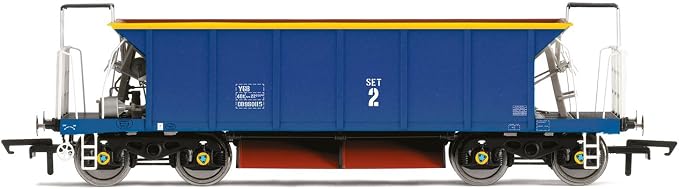
The design for the Fishkind-coded ‘Seacow’ wagons was based on a 1903 design by the London and South Western Railway. A typical hopper wagon would have slab sides with seven vertical ribs and three discharge chutes. These chutes were situated at the outside of each rail and in the centre. The end of the wagon featured three handwheels to control the chute doors. A total of 128 wagons were constructed at Shildon Works in 1971. The last 28 wagons were intended to operate in the Southern Region and featured air brakes with a vacuum through pipe. Under BR TOPS, the 28 wagons were coded YGB and with the Fishkind code ‘Seacow’. Between 1981 and 1982, 251 ‘Seacow’ wagons were constructed by Shildon Works and Ashford Works. These last batch of wagons largely followed the original 1903 design but featured different variations also. Hopper bodies were welded instead of rivetted, each vertical rib was formed of box sections instead of U-sections and there were more modern bogies.
The design for the Fishkind-coded ‘Seacow’ wagons was based on a 1903 design by the London and South Western Railway. A typical hopper wagon would have slab sides with seven vertical ribs and three discharge chutes. These chutes were situated at the outside of each rail and in the centre. The end of the wagon featured three handwheels to control the chute doors. A total of 128 wagons were constructed at Shildon Works in 1971. The last 28 wagons were intended to operate in the Southern Region and featured air brakes with a vacuum through pipe. Under BR TOPS, the 28 wagons were coded YGB and with the Fishkind code ‘Seacow’. Between 1981 and 1982, 251 ‘Seacow’ wagons were constructed by Shildon Works and Ashford Works. These last batch of wagons largely followed the original 1903 design but featured different variations also. Hopper bodies were welded instead of rivetted, each vertical rib was formed of box sections instead of U-sections and there were more modern bogies.
The design for the Fishkind-coded ‘Seacow’ wagons was based on a 1903 design by the London and South Western Railway. A typical hopper wagon would have slab sides with seven vertical ribs and three discharge chutes. These chutes were situated at the outside of each rail and in the centre. The end of the wagon featured three handwheels to control the chute doors. A total of 128 wagons were constructed at Shildon Works in 1971. The last 28 wagons were intended to operate in the Southern Region and featured air brakes with a vacuum through pipe. Under BR TOPS, the 28 wagons were coded YGB and with the Fishkind code ‘Seacow’. Between 1981 and 1982, 251 ‘Seacow’ wagons were constructed by Shildon Works and Ashford Works. These last batch of wagons largely followed the original 1903 design but featured different variations also. Hopper bodies were welded instead of rivetted, each vertical rib was formed of box sections instead of U-sections and there were more modern bogies.
The design for the Fishkind-coded ‘Seacow’ wagons was based on a 1903 design by the London and South Western Railway. A typical hopper wagon would have slab sides with seven vertical ribs and three discharge chutes. These chutes were situated at the outside of each rail and in the centre. The end of the wagon featured three handwheels to control the chute doors. A total of 128 wagons were constructed at Shildon Works in 1971. The last 28 wagons were intended to operate in the Southern Region and featured air brakes with a vacuum through pipe. Under BR TOPS, the 28 wagons were coded YGB and with the Fishkind code ‘Seacow’. Between 1981 and 1982, 251 ‘Seacow’ wagons were constructed by Shildon Works and Ashford Works. These last batch of wagons largely followed the original 1903 design but featured different variations also. Hopper bodies were welded instead of rivetted, each vertical rib was formed of box sections instead of U-sections and there were more modern bogies.
Last updated at 06/24/2026 20:57:13
Hornby OO Mainline YGB 'Seacow' DB980115 - Era 9
Delivery between 30 June – 3 July $9.95
Hornby OO Mainline YGB "Seacow" - Era 9
Delivery $14.90
Hornby OO Mainline YGB "Seacow" - Era 9
Delivery $9.90
Hornby OO Mainline YGB 'Seacow' DB980115 - Era 9
Delivery between 30 June – 3 July $9.95
Hornby OO Mainline YGB "Seacow" - Era 9
Delivery $14.90
Hornby OO Mainline YGB "Seacow" - Era 9
Delivery $9.90

