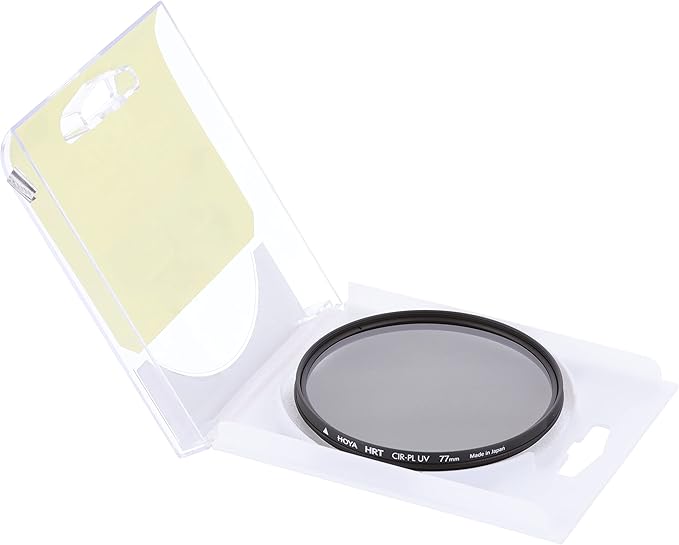
Uses a high rate transmission polarizing film Reduces exposure 1.1 Stops The glass absorbs ultra-violet (UV) rays to improve contrast and color These filters offer both amateur and professional photographers HOYA's famous quality at reasonable prices. They have coatings applied to both surfaces to suppress reflection and increase light transmission. The HOYA HRT circular polarizer filter uses a newly developed High-Rate Transparency film that passes more visible light through the filter while still filtering the same amount of polarized light, this means it can transmit as much as 25% more light through the polarizing film giving the photographer about 1/3 stop more light than a standard circular polarizer. This new polarizing film is also used in the latest HD LCD TVs. The glass of the HOYA HRT filter also has UV absorbing properties making the HRT a combination UV & Circular Polarizing filter. The most common use for a circular polarizer filter is to darken bright blue skies in outdoor photography, but they can also reduce or eliminate reflections from non-metallic surfaces such as glass and water. By rotating the outer ring of the filter the change of effect can be seen by looking though the filter or through the viewfinder if it is mounted on a camera. HOYA is the world's largest optical glass manufacturer, producing glass to specification for almost every camera and lens manufacturer. HOYA is also the world's largest optical filter manufacturer.
Uses a high rate transmission polarizing film Reduces exposure 1.1 Stops The glass absorbs ultra-violet (UV) rays to improve contrast and color These filters offer both amateur and professional photographers HOYA's famous quality at reasonable prices. They have coatings applied to both surfaces to suppress reflection and increase light transmission. The HOYA HRT circular polarizer filter uses a newly developed High-Rate Transparency film that passes more visible light through the filter while still filtering the same amount of polarized light, this means it can transmit as much as 25% more light through the polarizing film giving the photographer about 1/3 stop more light than a standard circular polarizer. This new polarizing film is also used in the latest HD LCD TVs. The glass of the HOYA HRT filter also has UV absorbing properties making the HRT a combination UV & Circular Polarizing filter. The most common use for a circular polarizer filter is to darken bright blue skies in outdoor photography, but they can also reduce or eliminate reflections from non-metallic surfaces such as glass and water. By rotating the outer ring of the filter the change of effect can be seen by looking though the filter or through the viewfinder if it is mounted on a camera. HOYA is the world's largest optical glass manufacturer, producing glass to specification for almost every camera and lens manufacturer. HOYA is also the world's largest optical filter manufacturer.
Uses a high rate transmission polarizing film Reduces exposure 1.1 Stops The glass absorbs ultra-violet (UV) rays to improve contrast and color These filters offer both amateur and professional photographers HOYA's famous quality at reasonable prices. They have coatings applied to both surfaces to suppress reflection and increase light transmission. The HOYA HRT circular polarizer filter uses a newly developed High-Rate Transparency film that passes more visible light through the filter while still filtering the same amount of polarized light, this means it can transmit as much as 25% more light through the polarizing film giving the photographer about 1/3 stop more light than a standard circular polarizer. This new polarizing film is also used in the latest HD LCD TVs. The glass of the HOYA HRT filter also has UV absorbing properties making the HRT a combination UV & Circular Polarizing filter. The most common use for a circular polarizer filter is to darken bright blue skies in outdoor photography, but they can also reduce or eliminate reflections from non-metallic surfaces such as glass and water. By rotating the outer ring of the filter the change of effect can be seen by looking though the filter or through the viewfinder if it is mounted on a camera. HOYA is the world's largest optical glass manufacturer, producing glass to specification for almost every camera and lens manufacturer. HOYA is also the world's largest optical filter manufacturer.
Uses a high rate transmission polarizing film Reduces exposure 1.1 Stops The glass absorbs ultra-violet (UV) rays to improve contrast and color These filters offer both amateur and professional photographers HOYA's famous quality at reasonable prices. They have coatings applied to both surfaces to suppress reflection and increase light transmission. The HOYA HRT circular polarizer filter uses a newly developed High-Rate Transparency film that passes more visible light through the filter while still filtering the same amount of polarized light, this means it can transmit as much as 25% more light through the polarizing film giving the photographer about 1/3 stop more light than a standard circular polarizer. This new polarizing film is also used in the latest HD LCD TVs. The glass of the HOYA HRT filter also has UV absorbing properties making the HRT a combination UV & Circular Polarizing filter. The most common use for a circular polarizer filter is to darken bright blue skies in outdoor photography, but they can also reduce or eliminate reflections from non-metallic surfaces such as glass and water. By rotating the outer ring of the filter the change of effect can be seen by looking though the filter or through the viewfinder if it is mounted on a camera. HOYA is the world's largest optical glass manufacturer, producing glass to specification for almost every camera and lens manufacturer. HOYA is also the world's largest optical filter manufacturer.
originally posted on bhphotovideo.com
I have a modified Nikon D5600 IR filter removed. Wanted to use this to cut the IR for times when I want to take photos with visible light and natural color. With out tearing the camera apart. But this filter did not remove all the IR. I sent it back. Hoya makes good filters, but my use case may not be typical for this filter.
originally posted on ebay.com
bought the product because i was going to potentially sandy and wet areas of Australia, and i was happy with the same product of other diameter so i just bought the same thing at different size to protect all my lens (only fitted at the location) the product is excellent, i tried with and without it, exactly same ghosting and flares, so it means its just my lens not the filter. As expected sand flew and sea spray was all over the place, the product did its job, but it is very irritating to clean. the best way to clean is blower and lens pen. Microfiber cloth is hopeless for this product. if you grab the lens the frame can rotate, for the price, its fine. In terms of UV filtering, i would say its useless for digital. My ultra zoom shots with and without were ... Morebought the product because i was going to potentially sandy and wet areas of Australia, and i was happy with the same product of other diameter so i just bought the same thing at different size to protect all my lens (only fitted at the location) the product is excellent, i tried with and without it, exactly same ghosting and flares, so it means its just my lens not the filter. As expected sand flew and sea spray was all over the place, the product did its job, but it is very irritating to clean. the best way to clean is blower and lens pen. Microfiber cloth is hopeless for this product. if you grab the lens the frame can rotate, for the price, its fine. In terms of UV filtering, i would say its useless for digital. My ultra zoom shots with and without were identical. In terms of IQ and sharpness etc, i don't pixel peep but there is no difference to me, anyway i post process everything to my preference. i do not have other products to compare with, but i can acknowledge that most of the pros and cons are same as most people claim online.
originally posted on ebay.com
The Hoya Alpha CPL offers a lot of value for a low price. The glass is a bit difficult to clean and is EXTREMELY susceptible to streaks. I find that the easiest way to clean it is to breathe on it and immediately wipe off with a dry microfiber cloth. The only optical problem with this filter is that any in-frame point-source light (street lamp, sun, headlight, flashlight, candle, etc) will create a very prominent flare. To eliminate this, do your best to keep point-source lights out of frame. Unscrewing is a little difficult. It would be much easier if the ridged section stuck out more, it wouldn't be such a big deal. Overall, this is about the best CPL you're going to get for under $50.
| General | |
| Product Type | Filter |
| Form Factor | Round |
| Filter Diameter | 77 mm |
| Filter |
I have a modified Nikon D5600 IR filter removed. Wanted to use this to cut the IR for times when I want to take photos with visible light and natural color. With out tearing the camera apart. But this filter did not remove all the IR. I sent it back. Hoya makes good filters, but my use case may not be typical for this filter.
bought the product because i was going to potentially sandy and wet areas of Australia, and i was happy with the same product of other diameter so i just bought the same thing at different size to protect all my lens (only fitted at the location) the product is excellent, i tried with and without it, exactly same ghosting and flares, so it means its just my lens not the filter. As expected sand flew and sea spray was all over the place, the product did its job, but it is very irritating to clean. the best way to clean is blower and lens pen. Microfiber cloth is hopeless for this product. if you grab the lens the frame can rotate, for the price, its fine. In terms of UV filtering, i would say its useless for digital. My ultra zoom shots with and without were ... Morebought the product because i was going to potentially sandy and wet areas of Australia, and i was happy with the same product of other diameter so i just bought the same thing at different size to protect all my lens (only fitted at the location) the product is excellent, i tried with and without it, exactly same ghosting and flares, so it means its just my lens not the filter. As expected sand flew and sea spray was all over the place, the product did its job, but it is very irritating to clean. the best way to clean is blower and lens pen. Microfiber cloth is hopeless for this product. if you grab the lens the frame can rotate, for the price, its fine. In terms of UV filtering, i would say its useless for digital. My ultra zoom shots with and without were identical. In terms of IQ and sharpness etc, i don't pixel peep but there is no difference to me, anyway i post process everything to my preference. i do not have other products to compare with, but i can acknowledge that most of the pros and cons are same as most people claim online.
The Hoya Alpha CPL offers a lot of value for a low price. The glass is a bit difficult to clean and is EXTREMELY susceptible to streaks. I find that the easiest way to clean it is to breathe on it and immediately wipe off with a dry microfiber cloth. The only optical problem with this filter is that any in-frame point-source light (street lamp, sun, headlight, flashlight, candle, etc) will create a very prominent flare. To eliminate this, do your best to keep point-source lights out of frame. Unscrewing is a little difficult. It would be much easier if the ridged section stuck out more, it wouldn't be such a big deal. Overall, this is about the best CPL you're going to get for under $50.
I purchased this filter to use on my 70-300mm lens when shooting telephoto landscapes/skyscapes. This filter is about what I expected for the $30 price point. The glass tends to smudge easily but the optical quality seems to be very good. At the longer focal lengths I am using, the polarization effect available usually isn't drastic, but when used in the right situation it effectively cuts through haze and preserves/improves definition, saturation, and dynamic range very satisfactorily. It is a bit difficult to get started threading onto my lens but attaches securely and is easy to remove. The rotating ring has the perfect amount of play in it- not too tight, not too loose. Overall I am happy with the performance of this filter and think it is well worth the money.
This filter is way better than Tiffen filters. I use it to protect my lenses when working at the field. Some photos are taken exposing the lens for long time or from a boat at sea, and a filter is a must have to protect it against blowing sand, dirty splash and so much more. I had used UV filters from Tiffen for more than 15 years and they work, are well known and accessible. However, if you have a prime lens, you do not want to use a medium filter compromising that sharp optics. A good filter may cost a lot and become out of reach. This filter is in between. It is way better than Tiffen, but does not cost as much as an HD Hoya filter. It does protect my prime lenses without damaging its optics and if I need an even sharper image, I just remove it, take the shot and ... MoreThis filter is way better than Tiffen filters. I use it to protect my lenses when working at the field. Some photos are taken exposing the lens for long time or from a boat at sea, and a filter is a must have to protect it against blowing sand, dirty splash and so much more. I had used UV filters from Tiffen for more than 15 years and they work, are well known and accessible. However, if you have a prime lens, you do not want to use a medium filter compromising that sharp optics. A good filter may cost a lot and become out of reach. This filter is in between. It is way better than Tiffen, but does not cost as much as an HD Hoya filter. It does protect my prime lenses without damaging its optics and if I need an even sharper image, I just remove it, take the shot and put it back. I leave this filter on most of the time and recommend it to my friends.
While digital camera sensors are designed to more insensitive to UV compared to film, the front-end lens protection is important when I remove my lens hood. Becasue the UB filter is multi-coated, internal flaring is minimized. This can be seen by holding the back-side of the filter and the reflection off the glass will be a darkened olive/green color. Other UV filters that have no coatings or just a single coating have a relection like ordinary glass would have. This is a big value offered by Hoya Multi-Coated filters.
I've owned this product in the past, and I trust this brand. It met all my expectations as a repeat customer.It's not the best in the world but does what it's supposed to do in its price range.
Hoya filters are great for at their price range. They have clean and full effect on the whole lens field , which in turn gives you consistent balance to your image. The minus one star that many filters in this price range, is that are little more prone to "lens flares" than, the higher priced range of the filter family. That is only a minor problem which can be reduced by lens hoods, and noticing the position of the sun or lighting, if you are staging a shoot. Over all, the quality of the filters I say are excellent.
In my opinion this is the best you can buy with the least amount of investment to spice up your outdoor photography! I mounted on my Canon 6D and Fuji X-T10 and made several shots at Waimanalo beach in Oahu, HI. The results were spectacular. Digital photographers have become so used to using post processing Polarlizing filter effects and so on these days and somehow forgotten what film photography was like. The use of this filter reminded me of good old film photography using Fujichrome Velvia 50 and Kodachrome 25. One thing that has bothered me about the use of polarizing filter on digital camera is that the effect of UV blue effect often came out too strong to muddy the nature photography's color rendition. While many DSLR have UV filter effect that you can apply ... MoreIn my opinion this is the best you can buy with the least amount of investment to spice up your outdoor photography! I mounted on my Canon 6D and Fuji X-T10 and made several shots at Waimanalo beach in Oahu, HI. The results were spectacular. Digital photographers have become so used to using post processing Polarlizing filter effects and so on these days and somehow forgotten what film photography was like. The use of this filter reminded me of good old film photography using Fujichrome Velvia 50 and Kodachrome 25. One thing that has bothered me about the use of polarizing filter on digital camera is that the effect of UV blue effect often came out too strong to muddy the nature photography's color rendition. While many DSLR have UV filter effect that you can apply later, they are not the perfect solution. Hoya has achieved amazing color cleanliness by adding UV filtering element into this wonderful Polarlzer. Optical resolution is far greater than those cheap low end filters that often come as part of kits. Just put one of these filters on and go find the blue water! You will be so pleased that you will not be messing with Photoshop crapping color faking technology any more. Highly recommended!
Excellent value for the price! Hoya never lets me down. I have mostly 77mm lenses, so it fits almost everything I have. It will darken the sky by (I'm guessing) 2-3 f-stops when used perpendicularly to the sun, and has a "wider" area of effectiveness than some of the cheaper ones, meaning that the unaffacted brighter area around the edge of the frame where the sky is, is smaller than my previous CP. It also cuts through water and reflection very well, and increases saturation nicely. Would absolutely recommend! A kust have for any photographer's toolbox.
| General | |
| Product Type | Filter |
| Form Factor | Round |
| Filter Diameter | 77 mm |
| Filter |

