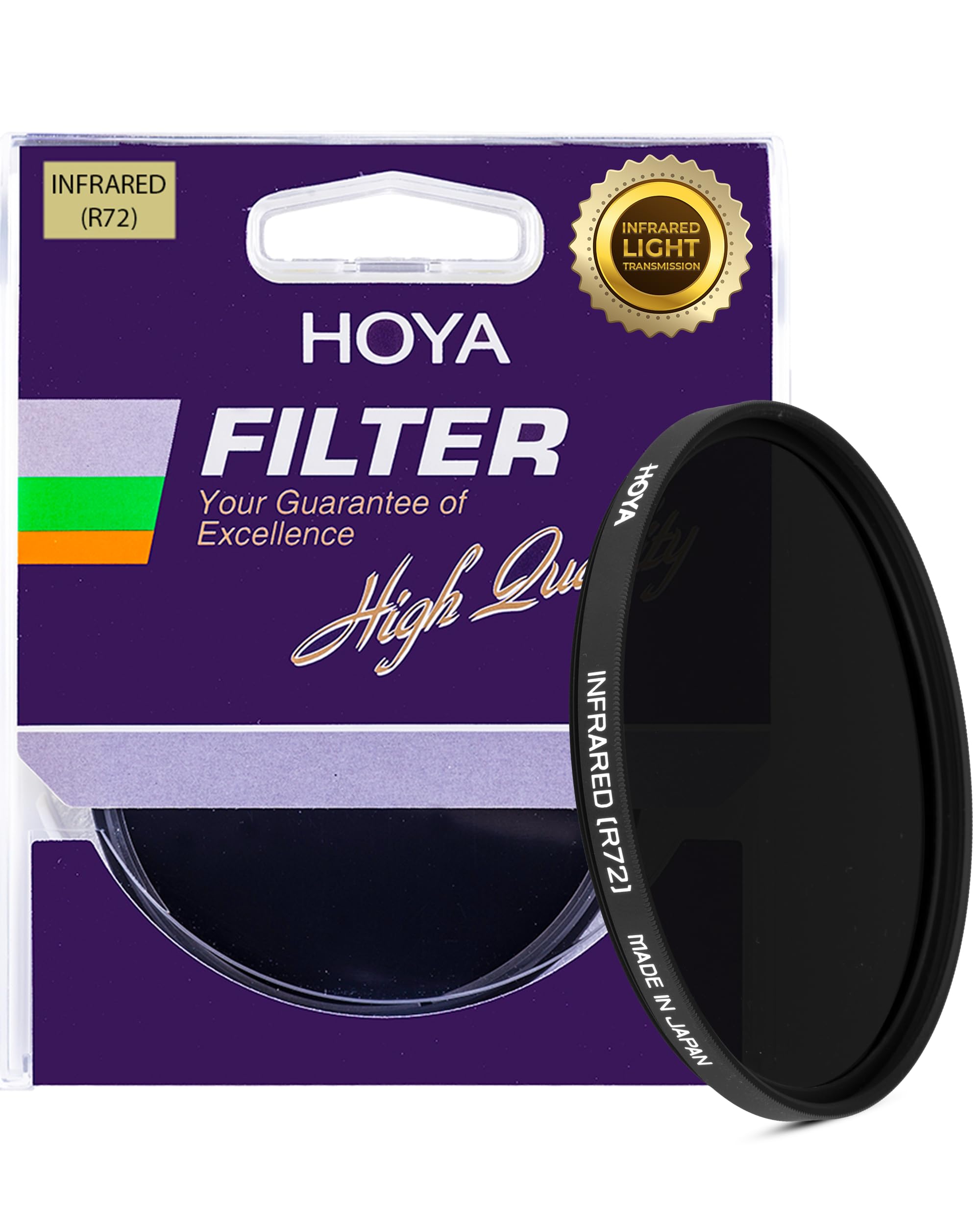
The HOYA R72 infrared filter is specially designed for infrared photography with digital cameras and infrared film. Infrared light begins in the high red region of the visible spectrum at about 750 nm and extends beyond 1000 nm. When viewed through the R72 filter, it looks almost opaque because the filter only allows light from the very high red edge of the visible spectrum and infrared light to pass through. Due to the nature of infrared light, the filter factor and exposure compensation are very different from visible light and depend largely on lighting conditions. The Hoya R72 works well with digital cameras, especially mirrorless cameras or DSLRS without an IR cut filter in front of the sensor. (Please check the user manual of your camera). The filter allows light to pass completely at 760 nm - 860 nm. (Infrared spectrum) with a light transmission of 95%. The HOYA R72 is made of high quality Hoya optical glass mounted in a precision machined aluminum frame for rigidity. Can be combined with colored black and white contrast filters such as the R25 (red), K2 (yellow), O (orange) or other color filters to change color rendition or contrast effects.
The HOYA R72 infrared filter is specially designed for infrared photography with digital cameras and infrared film. Infrared light begins in the high red region of the visible spectrum at about 750 nm and extends beyond 1000 nm. When viewed through the R72 filter, it looks almost opaque because the filter only allows light from the very high red edge of the visible spectrum and infrared light to pass through. Due to the nature of infrared light, the filter factor and exposure compensation are very different from visible light and depend largely on lighting conditions. The Hoya R72 works well with digital cameras, especially mirrorless cameras or DSLRS without an IR cut filter in front of the sensor. (Please check the user manual of your camera). The filter allows light to pass completely at 760 nm - 860 nm. (Infrared spectrum) with a light transmission of 95%. The HOYA R72 is made of high quality Hoya optical glass mounted in a precision machined aluminum frame for rigidity. Can be combined with colored black and white contrast filters such as the R25 (red), K2 (yellow), O (orange) or other color filters to change color rendition or contrast effects.
The HOYA R72 infrared filter is specially designed for infrared photography with digital cameras and infrared film. Infrared light begins in the high red region of the visible spectrum at about 750 nm and extends beyond 1000 nm. When viewed through the R72 filter, it looks almost opaque because the filter only allows light from the very high red edge of the visible spectrum and infrared light to pass through. Due to the nature of infrared light, the filter factor and exposure compensation are very different from visible light and depend largely on lighting conditions. The Hoya R72 works well with digital cameras, especially mirrorless cameras or DSLRS without an IR cut filter in front of the sensor. (Please check the user manual of your camera). The filter allows light to pass completely at 760 nm - 860 nm. (Infrared spectrum) with a light transmission of 95%. The HOYA R72 is made of high quality Hoya optical glass mounted in a precision machined aluminum frame for rigidity. Can be combined with colored black and white contrast filters such as the R25 (red), K2 (yellow), O (orange) or other color filters to change color rendition or contrast effects.
The HOYA R72 infrared filter is specially designed for infrared photography with digital cameras and infrared film. Infrared light begins in the high red region of the visible spectrum at about 750 nm and extends beyond 1000 nm. When viewed through the R72 filter, it looks almost opaque because the filter only allows light from the very high red edge of the visible spectrum and infrared light to pass through. Due to the nature of infrared light, the filter factor and exposure compensation are very different from visible light and depend largely on lighting conditions. The Hoya R72 works well with digital cameras, especially mirrorless cameras or DSLRS without an IR cut filter in front of the sensor. (Please check the user manual of your camera). The filter allows light to pass completely at 760 nm - 860 nm. (Infrared spectrum) with a light transmission of 95%. The HOYA R72 is made of high quality Hoya optical glass mounted in a precision machined aluminum frame for rigidity. Can be combined with colored black and white contrast filters such as the R25 (red), K2 (yellow), O (orange) or other color filters to change color rendition or contrast effects.
Last updated at 05/10/2026 19:56:16
Hoya 49mm Infrared R72 Filter
Affiliate Disclosure: We may receive a small commission for purchases made through this link at no extra cost to you. This helps support our site. Thank you!
Hoya 49mm R72 Infrared Filter
Delivery $4.90
HOYA 49mm R72 INFRARED Filter
Delivery between 15–19 May $8.95
Hoya 49mm R72 Infrared
14-day returns
Hoya 49mm R72 Infrared Filter
Delivery $9.90
Hoya R72 Infrared Filter - 49mm
Delivery $14.95
Hoya 49mm R72 Infrared Filter (c643049)
Delivery $5
Affiliate Disclosure: We may receive a small commission for purchases made through this link at no extra cost to you. This helps support our site. Thank you!
Hoya R72 Infrared Filter
Delivery $9.99
Hoya 49mm R72 Infrared Filter
Delivery between 13–18 May $12.90
Hoya 49mm R72 Infrared Filter
Delivery $9.95
originally posted on bhphotovideo.com
I've never used any kind of IR filter before and wanted to get a feel for how the process worked, what I could expect and have a general baseline for whether I wanted to pursue it further. As an introductory product I would actually rate this 5 stars instead of 4. As such, it is a wonderful piece of gear to get an introduction to IR photography but I will definitely be pursuing higher quality with my next purchase.However, I use many high quality products so I recognize when corners have been cut and Hoya has done so with this product. For starters, the glass is, well, kind of loose, within the mounting ring. There's not loss of performance that I've been able to tell but it's weird to be cleaning the filter and have the glass moving underneath your cloth. Another ... MoreI've never used any kind of IR filter before and wanted to get a feel for how the process worked, what I could expect and have a general baseline for whether I wanted to pursue it further. As an introductory product I would actually rate this 5 stars instead of 4. As such, it is a wonderful piece of gear to get an introduction to IR photography but I will definitely be pursuing higher quality with my next purchase.However, I use many high quality products so I recognize when corners have been cut and Hoya has done so with this product. For starters, the glass is, well, kind of loose, within the mounting ring. There's not loss of performance that I've been able to tell but it's weird to be cleaning the filter and have the glass moving underneath your cloth. Another thing is the mounting ring itself in that it just "feels" off and of middling quality with the threads squeaking and dragging as I mount it to the front of the lens.I wouldn't let these little quirks dissuade you from making this purchase if you, like me, are seeking something to give you a start in IR photography without having to break the bank on something higher quality before you know you want to pursue this style. If you already have other IR filter however and are looking to expand your range then I would recommend looking from something better.
originally posted on adorama.com
Have went out 3 times now with this new filter. Love it!! works best in bright sun mid day. Just another toy in my collection. One that lets me enjoy photography when most other types of photography does not work (high noon). You will potentially get a hot spot in the middle that is caused by lens selection and not shooting relatively wide open. However by testing thru a few lenses and F-stops i have it nailed now. Again great toy for under 100$. Watch some youtube videos on processing the photos and how you need to download and use the free Adobe DNG editor to create a profile for your camera.
originally posted on adorama.com
I previously owned the 52mm R-72 filter and used it on the APS-C Sigma 30mm f1.4 with some success.I purchased the 58mm size so I could use it on a few different Fujifilm APS-C lenses (e.g. XF 23mm F1.4 R LM WR). It has helped me in taking some interesting black and white IR-ish photos and I hope to further experiment with it (while working on my post processing technique).Be prepared to get out a tripod for long exposure times or shoot wide open in the middle of the day.
| General | |
| Product Type | Filter |
| Form Factor | Round |
| Filter Diameter | 49 mm |
| Filter |
Hoya 49mm Infrared R72 Filter
Affiliate Disclosure: We may receive a small commission for purchases made through this link at no extra cost to you. This helps support our site. Thank you!
Hoya 49mm R72 Infrared Filter
Delivery $4.90
HOYA 49mm R72 INFRARED Filter
Delivery between 15–19 May $8.95
Hoya 49mm R72 Infrared
14-day returns
Hoya 49mm R72 Infrared Filter
Delivery $9.90
I've never used any kind of IR filter before and wanted to get a feel for how the process worked, what I could expect and have a general baseline for whether I wanted to pursue it further. As an introductory product I would actually rate this 5 stars instead of 4. As such, it is a wonderful piece of gear to get an introduction to IR photography but I will definitely be pursuing higher quality with my next purchase.However, I use many high quality products so I recognize when corners have been cut and Hoya has done so with this product. For starters, the glass is, well, kind of loose, within the mounting ring. There's not loss of performance that I've been able to tell but it's weird to be cleaning the filter and have the glass moving underneath your cloth. Another ... MoreI've never used any kind of IR filter before and wanted to get a feel for how the process worked, what I could expect and have a general baseline for whether I wanted to pursue it further. As an introductory product I would actually rate this 5 stars instead of 4. As such, it is a wonderful piece of gear to get an introduction to IR photography but I will definitely be pursuing higher quality with my next purchase.However, I use many high quality products so I recognize when corners have been cut and Hoya has done so with this product. For starters, the glass is, well, kind of loose, within the mounting ring. There's not loss of performance that I've been able to tell but it's weird to be cleaning the filter and have the glass moving underneath your cloth. Another thing is the mounting ring itself in that it just "feels" off and of middling quality with the threads squeaking and dragging as I mount it to the front of the lens.I wouldn't let these little quirks dissuade you from making this purchase if you, like me, are seeking something to give you a start in IR photography without having to break the bank on something higher quality before you know you want to pursue this style. If you already have other IR filter however and are looking to expand your range then I would recommend looking from something better.
Have went out 3 times now with this new filter. Love it!! works best in bright sun mid day. Just another toy in my collection. One that lets me enjoy photography when most other types of photography does not work (high noon). You will potentially get a hot spot in the middle that is caused by lens selection and not shooting relatively wide open. However by testing thru a few lenses and F-stops i have it nailed now. Again great toy for under 100$. Watch some youtube videos on processing the photos and how you need to download and use the free Adobe DNG editor to create a profile for your camera.
I previously owned the 52mm R-72 filter and used it on the APS-C Sigma 30mm f1.4 with some success.I purchased the 58mm size so I could use it on a few different Fujifilm APS-C lenses (e.g. XF 23mm F1.4 R LM WR). It has helped me in taking some interesting black and white IR-ish photos and I hope to further experiment with it (while working on my post processing technique).Be prepared to get out a tripod for long exposure times or shoot wide open in the middle of the day.
This filter works well and as expected. Here's a quick how-to for folks brand new to the medium. There are many (more detailed) tutorials online, but if you just want to make your first image quickly, hopefully this will help.What to expect:With the 720 filter, images straight out of the camera will look dull orange and a glowing, bluish white. You can leave it as is, manipulate the colors to your liking, or process into stunning black & white.SHOOTING1. Set up. Because most visible light will be filtered out, you'll need to use a long exposure. A tripod is very useful here. (Or set your camera on something steady and secure.)2. Compose. The viewfinder will be quite dark, so use Live View if your camera has it. If not, try composing and setting the focus ... MoreThis filter works well and as expected. Here's a quick how-to for folks brand new to the medium. There are many (more detailed) tutorials online, but if you just want to make your first image quickly, hopefully this will help.What to expect:With the 720 filter, images straight out of the camera will look dull orange and a glowing, bluish white. You can leave it as is, manipulate the colors to your liking, or process into stunning black & white.SHOOTING1. Set up. Because most visible light will be filtered out, you'll need to use a long exposure. A tripod is very useful here. (Or set your camera on something steady and secure.)2. Compose. The viewfinder will be quite dark, so use Live View if your camera has it. If not, try composing and setting the focus before (carefully) screwing on the filter, then press the shutter.3. Note: Shoot in RAW for the most flexibility. However, if you're just starting out and feel the process bogging you down, JPGs can still give fast, interesting results.POST-PROCESSING1. First, adjust the white balance of your RAW image to give the best contrast and color adjustment.2. Apply any other creative editing you like.Have fun!
I've been using Hoya filters ever since a friend, manager at The Camera Barn on 198 Broadway recommended them to me. That was in the mid1960s! I believe at that time, The Camera Barn was importing these filters. I have used more expensive filters from German OEM companies, and some that are obviously re-branded Hoya filters and are given prestigious European brand, but for the price and quality, you CAN'T beat Hoya's line of filters. Since they have introduced their HMC line years, that's all I use. You can't go wrong with Hoya. They are also one of two houses which makes and sell optical glass to German and Japanese lens manufacturers. The other is German-owned. It's been a very long time since OEM lens makers, e.g., Nikon, Minolta and Leitz made their own optical ... MoreI've been using Hoya filters ever since a friend, manager at The Camera Barn on 198 Broadway recommended them to me. That was in the mid1960s! I believe at that time, The Camera Barn was importing these filters. I have used more expensive filters from German OEM companies, and some that are obviously re-branded Hoya filters and are given prestigious European brand, but for the price and quality, you CAN'T beat Hoya's line of filters. Since they have introduced their HMC line years, that's all I use. You can't go wrong with Hoya. They are also one of two houses which makes and sell optical glass to German and Japanese lens manufacturers. The other is German-owned. It's been a very long time since OEM lens makers, e.g., Nikon, Minolta and Leitz made their own optical glass. For their price and quality, you can't go wrong, so WHAT'S NOT TO LIKE?
I spent an afternoon a few months ago trying to master the exposure needed to produce a clean image. The challenge is to frame the shot, then screw the filter on the lens and bracket until your exposure looks about "right". My problem is that no matter how many tutorials I looked up, I could never seem to get rid of the red tint without completely converting to a black and white image. I've seen so many examples where the image is a beautiful white with blue tones, but mine was always just pink. I'm not sure if I'm doing something wrong in post production or if this lens just can't do what I want it to do. I finally found a day (yesterday) where I could focus entirely on mastering the techniques. I was ready to try converting the color channels to see if that would ... MoreI spent an afternoon a few months ago trying to master the exposure needed to produce a clean image. The challenge is to frame the shot, then screw the filter on the lens and bracket until your exposure looks about "right". My problem is that no matter how many tutorials I looked up, I could never seem to get rid of the red tint without completely converting to a black and white image. I've seen so many examples where the image is a beautiful white with blue tones, but mine was always just pink. I'm not sure if I'm doing something wrong in post production or if this lens just can't do what I want it to do. I finally found a day (yesterday) where I could focus entirely on mastering the techniques. I was ready to try converting the color channels to see if that would give me the results I wanted. I set up my first shot, started to screw the lens in, it slipped out of my hand and onto the concrete. The entire lens cracked diagonally and one chunk is gone. I still tried a few shots to see what the light leak did for the image, but it's too big and distracting. I was hoping to finish my testing and write a review so others could benefit from my infrared experiments. I was also going to enter a infrared photo in an upcoming art show in a few weeks. I can't afford another infrared lens and it makes me very sad. If you buy one, know that there is post production work you'll have to master...and stay away from concrete.
These Hoya R72 filters are fabulous for IR photography. I don't use any other. Build quality and the filter case are superb. The IR effect is perfect. I shoot Rolleipan Infrared 400 on a semi regular basis and these filters render the IR effect flawlessly.
I have several R72 filters in other sizes and they are all solidly built filters. Hoya has been around forever and they know glass! Unlike some cheaper filters I've purchased, I've never seen any manufacturing defects in a Hoya. The R72 works great with my full-spectrum converted Z5 and D7000. Does not negatively impact image quality or sharpness.
This is one of the few filters you can't identify without either a flashlight or reading the edge text: it looks like a deep, black/neutral density filter. A flashlight will show read looking through it.Usually, you need to pre-focus and switch to manual before putting this filter on, to get focus where it needs to be. My R7 can figure out exposure with the filter on in daylight... at dusk, you gotta do the math, but it has nice effects.
Although I already own a Kolarivision 720 nm long-pass filter 49 mm in size, I wanted to have one for my Lensbaby optics without having to use a 46 - 49 mm step-up ring, so I purchased this filter.While I have not yet done a comparison between the Hoya and Kolarivision filters, I have not found any evidence of vignetting (which could happen given that the ring of this filter is not slender.) The filter threads screw on the lens mount without any difficulty.Presented here is a photo taken with a full spectrum-converted Sony a6700 camera using the Lensbaby Trio 28 - Sweet optic (42 mm full frame-equivalent focal length) followed by an iPhone SE2 visible light-only photo for comparison.
| General | |
| Product Type | Filter |
| Form Factor | Round |
| Filter Diameter | 49 mm |
| Filter |

