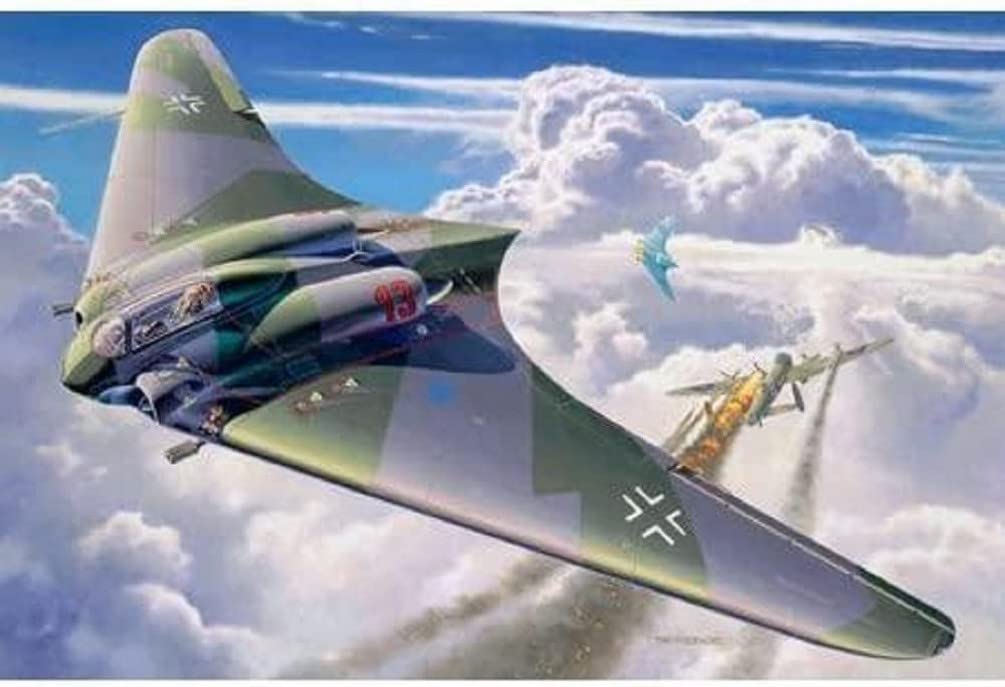
The brothers Reimar and Walter Horten were among the most renowned designers of flying wing aircraft in Germany until the end of World War II. They contributed their expertise to a special unit known as Sonderkommando 9, which was responsible for the further development of flying wing aircraft. The development of the machine designated Horten Ho IX, equipped with two BMW 003A-1 jet engines, began in 1942. While the first aircraft could only be completed as a glider due to difficulties with the jet engine, the second prototype was fitted with the Jumo 004B-1 engine. In 1944, the V2 made its first flight, achieving speeds of over 780 km/h. The series production of the Horten was assigned to the Gothaer Waggonfabrik, and the model designation was changed to Go 229. The first aircraft from Gothaer Waggonfabrik, the Go 229 A-O V3, was equipped with Jumo 004C engines. It features detailed surfaces with recessed panel joints, retractable landing gear options, detailed front and main landing gear, a detailed cockpit with instrument panel, two 30 mm cannons, a detailed engine front imitation, and thrust nozzle end area. Decals are included for two versions: Horten IX/Go 229, JG400, "Red 13" and Horten IX/Go 229, JG400, "Blue 4".
The brothers Reimar and Walter Horten were among the most renowned designers of flying wing aircraft in Germany until the end of World War II. They contributed their expertise to a special unit known as Sonderkommando 9, which was responsible for the further development of flying wing aircraft. The development of the machine designated Horten Ho IX, equipped with two BMW 003A-1 jet engines, began in 1942. While the first aircraft could only be completed as a glider due to difficulties with the jet engine, the second prototype was fitted with the Jumo 004B-1 engine. In 1944, the V2 made its first flight, achieving speeds of over 780 km/h. The series production of the Horten was assigned to the Gothaer Waggonfabrik, and the model designation was changed to Go 229. The first aircraft from Gothaer Waggonfabrik, the Go 229 A-O V3, was equipped with Jumo 004C engines. It features detailed surfaces with recessed panel joints, retractable landing gear options, detailed front and main landing gear, a detailed cockpit with instrument panel, two 30 mm cannons, a detailed engine front imitation, and thrust nozzle end area. Decals are included for two versions: Horten IX/Go 229, JG400, "Red 13" and Horten IX/Go 229, JG400, "Blue 4".
The brothers Reimar and Walter Horten were among the most renowned designers of flying wing aircraft in Germany until the end of World War II. They contributed their expertise to a special unit known as Sonderkommando 9, which was responsible for the further development of flying wing aircraft. The development of the machine designated Horten Ho IX, equipped with two BMW 003A-1 jet engines, began in 1942. While the first aircraft could only be completed as a glider due to difficulties with the jet engine, the second prototype was fitted with the Jumo 004B-1 engine. In 1944, the V2 made its first flight, achieving speeds of over 780 km/h. The series production of the Horten was assigned to the Gothaer Waggonfabrik, and the model designation was changed to Go 229. The first aircraft from Gothaer Waggonfabrik, the Go 229 A-O V3, was equipped with Jumo 004C engines. It features detailed surfaces with recessed panel joints, retractable landing gear options, detailed front and main landing gear, a detailed cockpit with instrument panel, two 30 mm cannons, a detailed engine front imitation, and thrust nozzle end area. Decals are included for two versions: Horten IX/Go 229, JG400, "Red 13" and Horten IX/Go 229, JG400, "Blue 4".
The brothers Reimar and Walter Horten were among the most renowned designers of flying wing aircraft in Germany until the end of World War II. They contributed their expertise to a special unit known as Sonderkommando 9, which was responsible for the further development of flying wing aircraft. The development of the machine designated Horten Ho IX, equipped with two BMW 003A-1 jet engines, began in 1942. While the first aircraft could only be completed as a glider due to difficulties with the jet engine, the second prototype was fitted with the Jumo 004B-1 engine. In 1944, the V2 made its first flight, achieving speeds of over 780 km/h. The series production of the Horten was assigned to the Gothaer Waggonfabrik, and the model designation was changed to Go 229. The first aircraft from Gothaer Waggonfabrik, the Go 229 A-O V3, was equipped with Jumo 004C engines. It features detailed surfaces with recessed panel joints, retractable landing gear options, detailed front and main landing gear, a detailed cockpit with instrument panel, two 30 mm cannons, a detailed engine front imitation, and thrust nozzle end area. Decals are included for two versions: Horten IX/Go 229, JG400, "Red 13" and Horten IX/Go 229, JG400, "Blue 4".
Last updated at 05/10/2026 13:59:46
Revell - Horten Go-229 Plane To Assemble And Paint - 1/72 - Rev04312
Delivery $237.69
Affiliate Disclosure: We may receive a small commission for purchases made through this link at no extra cost to you. This helps support our site. Thank you!
Revell 04312 - 1/72 Horten Go 229 - New
Affiliate Disclosure: We may receive a small commission for purchases made through this link at no extra cost to you. This helps support our site. Thank you!
Revell - Horten Go 229 1:72 Model Kit - 04312
Delivery $26.86
Affiliate Disclosure: We may receive a small commission for purchases made through this link at no extra cost to you. This helps support our site. Thank you!
Revell 1/72 Horten Go 229 Kit
Delivery between 13–25 May $9.90
Revell 1/72 Horten Go 229
Revell Horten Go-229 1:72
Delivery between 19–22 May $9.95
REVELL HORTEN GO-229 1:72
Delivery between 19–22 May $9.95
Prefab model 1/72 plane Horten Go 229 Revell 04312
Plastic ModelKit letadlo 04312 - Horten Go-229 (1:72)
Revell Horten Go-229 1/72
Delivery between 12–20 May $16.95
originally posted on megahobby.com
Very well produced kit of a very unique subject. The Horten could have been designed yesterday, with its futuristic, stealthy look. Revell of Germany captures it well with the usual quality fit and detail we have come to expect of their models.
originally posted on ebay.com
Revell's Horten Go 229 can't be beat for quality and cost. The fit is excellent and the final product is a real gem.
originally posted on ebay.com
The detail on this model is appropriate for viewing. This item's instructions are worth following. It takes time to build it right but it is worth the time to spend doing it.
| Skill level | 3 |
| Length | 105 mm |
| Wingspan | 232 mm |
| Parts | 70 |
| Age Range | 10-14 |
Revell - Horten Go-229 Plane To Assemble And Paint - 1/72 - Rev04312
Delivery $237.69
Affiliate Disclosure: We may receive a small commission for purchases made through this link at no extra cost to you. This helps support our site. Thank you!
Revell 04312 - 1/72 Horten Go 229 - New
Affiliate Disclosure: We may receive a small commission for purchases made through this link at no extra cost to you. This helps support our site. Thank you!
Revell - Horten Go 229 1:72 Model Kit - 04312
Delivery $26.86
Affiliate Disclosure: We may receive a small commission for purchases made through this link at no extra cost to you. This helps support our site. Thank you!
Revell 1/72 Horten Go 229 Kit
Delivery between 13–25 May $9.90
Revell 1/72 Horten Go 229
Very well produced kit of a very unique subject. The Horten could have been designed yesterday, with its futuristic, stealthy look. Revell of Germany captures it well with the usual quality fit and detail we have come to expect of their models.
Revell's Horten Go 229 can't be beat for quality and cost. The fit is excellent and the final product is a real gem.
The detail on this model is appropriate for viewing. This item's instructions are worth following. It takes time to build it right but it is worth the time to spend doing it.
Very unusual kit for a WWII craft that I don't think went into production. If you like unusual aircraft kits ( if I may say ) check out fantastic plastics virtual museum store.
I would say it's about a skill level 2. the outer surface detail is good, landing gear is good. No engine or or associated detail, cockpit detail is ok.
This is a Christmas present I got as requested. It looks like a great kit. It's not for me.
A nice "new tool" (circa 2000) of Horten's famous tailless fighter. Unlike most of the "Luftwaffe 46" aircraft, this one did actually make it off the drawing board, the remains of which are now in the Smithsonian museum currently undergoing restoration. The panel lines are nicely engraved and as far as I can tell the kit is accurate. To me it looks right and I work on the premise of "if it looks right then it is right". If you carry on with the "if it had gone into production" then you can get very creative with the variations of the "official" Luftwaffe camouflage schemes. I have said that it is durable, but that is within the usual limits of any plastic model kit. A great little model from Revell.
Very happy great kit Great addition to my collection
I was impressed with this one, but the name on the box is wrong - it's a horton ho 229 or a horton ix v3 - gotha go was never really a name and this seems to mess up on those names. With my model I painted it black, and will be adding US Army decals like this video from 1947 near Roswell, New Mexico... youtube JBnBSJ9bz3A
it is well presented good parts a very unusual but something that shows how far advanced the germans were a nice good quality kit and not to exspensive it todays prices
| Skill level | 3 |
| Length | 105 mm |
| Wingspan | 232 mm |
| Parts | 70 |
| Age Range | 10-14 |

