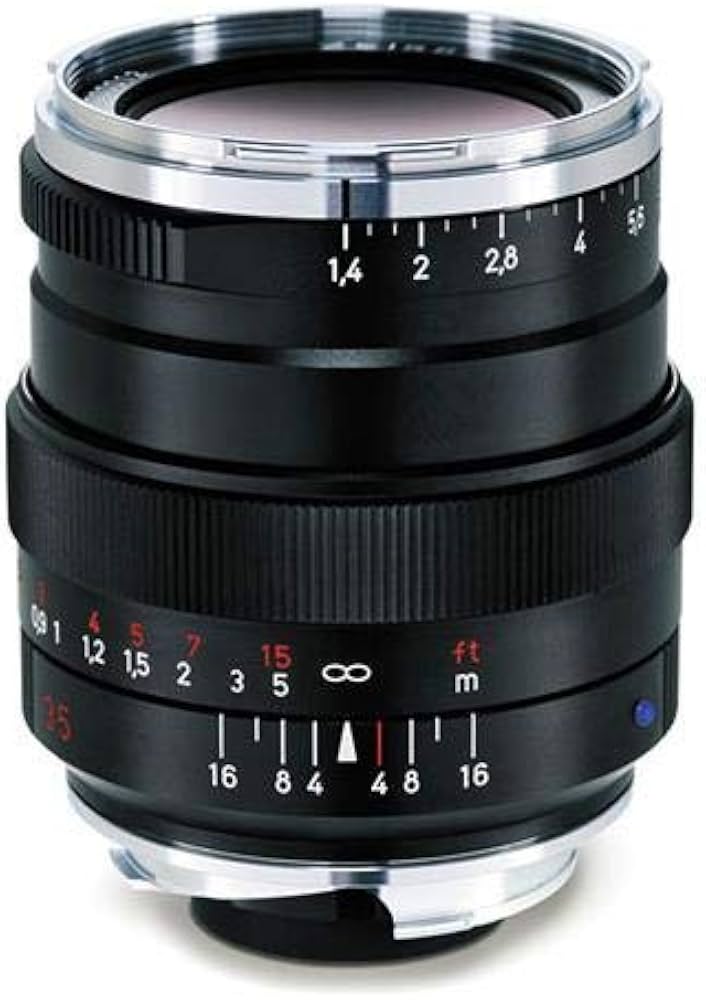
The Zeiss Distagon T* 35mm f/1.4 is the highest speed lens (Silver) in the ZM family. And thanks to its compact dimensions and a natural-feeling image rendition, this lens is perfectly suited to capture those special moments in life - and reproduce them in all their glory. High-Speed Lens Impressive photographs captured in low light always begin with a fast lens for a system or SLR camera. Because, a fast, high-performance lens captures as much light as possible. And a lens with a large maximum aperture leads to the best results when shooting in unfavorable light. Smooth, precise focusing Manually focusing a lens means controlling the image result from your fingertips. A good ergonomic design makes all the difference. The user-friendly focusing ring on ZEISS lenses with an ergonomic finger rest is perfect for fast, precise focusing. Changes are immediately visible in the viewfinder. The high-quality focusing mechanism moves smoothly without play, thus also supporting the intuitive interaction with the focal plane. Robust design The mount and control elements of all ZM lenses are made of metal and are designed for decades of intensive use. The high-quality craftsmanship of the all-metal mounts, the easy-to-grip metal focus and aperture ring and the robust front bayonet and filter threads ensure an amazing photographic experience. Excellent image quality The ZEISS range of T* lenses offers the highest possible standards in terms of performance, reliability and, of course, image quality. Quite simply, they are superior in every way. You can count on highly advanced flare control for crisp and brilliant images, for example. And virtually zero geometric distortion, ensuring precise accuracy when reproducing shapes especially useful when photographing products and architecture.
The Zeiss Distagon T* 35mm f/1.4 is the highest speed lens (Silver) in the ZM family. And thanks to its compact dimensions and a natural-feeling image rendition, this lens is perfectly suited to capture those special moments in life - and reproduce them in all their glory. High-Speed Lens Impressive photographs captured in low light always begin with a fast lens for a system or SLR camera. Because, a fast, high-performance lens captures as much light as possible. And a lens with a large maximum aperture leads to the best results when shooting in unfavorable light. Smooth, precise focusing Manually focusing a lens means controlling the image result from your fingertips. A good ergonomic design makes all the difference. The user-friendly focusing ring on ZEISS lenses with an ergonomic finger rest is perfect for fast, precise focusing. Changes are immediately visible in the viewfinder. The high-quality focusing mechanism moves smoothly without play, thus also supporting the intuitive interaction with the focal plane. Robust design The mount and control elements of all ZM lenses are made of metal and are designed for decades of intensive use. The high-quality craftsmanship of the all-metal mounts, the easy-to-grip metal focus and aperture ring and the robust front bayonet and filter threads ensure an amazing photographic experience. Excellent image quality The ZEISS range of T* lenses offers the highest possible standards in terms of performance, reliability and, of course, image quality. Quite simply, they are superior in every way. You can count on highly advanced flare control for crisp and brilliant images, for example. And virtually zero geometric distortion, ensuring precise accuracy when reproducing shapes especially useful when photographing products and architecture.
The Zeiss Distagon T* 35mm f/1.4 is the highest speed lens (Silver) in the ZM family. And thanks to its compact dimensions and a natural-feeling image rendition, this lens is perfectly suited to capture those special moments in life - and reproduce them in all their glory. High-Speed Lens Impressive photographs captured in low light always begin with a fast lens for a system or SLR camera. Because, a fast, high-performance lens captures as much light as possible. And a lens with a large maximum aperture leads to the best results when shooting in unfavorable light. Smooth, precise focusing Manually focusing a lens means controlling the image result from your fingertips. A good ergonomic design makes all the difference. The user-friendly focusing ring on ZEISS lenses with an ergonomic finger rest is perfect for fast, precise focusing. Changes are immediately visible in the viewfinder. The high-quality focusing mechanism moves smoothly without play, thus also supporting the intuitive interaction with the focal plane. Robust design The mount and control elements of all ZM lenses are made of metal and are designed for decades of intensive use. The high-quality craftsmanship of the all-metal mounts, the easy-to-grip metal focus and aperture ring and the robust front bayonet and filter threads ensure an amazing photographic experience. Excellent image quality The ZEISS range of T* lenses offers the highest possible standards in terms of performance, reliability and, of course, image quality. Quite simply, they are superior in every way. You can count on highly advanced flare control for crisp and brilliant images, for example. And virtually zero geometric distortion, ensuring precise accuracy when reproducing shapes especially useful when photographing products and architecture.
The Zeiss Distagon T* 35mm f/1.4 is the highest speed lens (Silver) in the ZM family. And thanks to its compact dimensions and a natural-feeling image rendition, this lens is perfectly suited to capture those special moments in life - and reproduce them in all their glory. High-Speed Lens Impressive photographs captured in low light always begin with a fast lens for a system or SLR camera. Because, a fast, high-performance lens captures as much light as possible. And a lens with a large maximum aperture leads to the best results when shooting in unfavorable light. Smooth, precise focusing Manually focusing a lens means controlling the image result from your fingertips. A good ergonomic design makes all the difference. The user-friendly focusing ring on ZEISS lenses with an ergonomic finger rest is perfect for fast, precise focusing. Changes are immediately visible in the viewfinder. The high-quality focusing mechanism moves smoothly without play, thus also supporting the intuitive interaction with the focal plane. Robust design The mount and control elements of all ZM lenses are made of metal and are designed for decades of intensive use. The high-quality craftsmanship of the all-metal mounts, the easy-to-grip metal focus and aperture ring and the robust front bayonet and filter threads ensure an amazing photographic experience. Excellent image quality The ZEISS range of T* lenses offers the highest possible standards in terms of performance, reliability and, of course, image quality. Quite simply, they are superior in every way. You can count on highly advanced flare control for crisp and brilliant images, for example. And virtually zero geometric distortion, ensuring precise accuracy when reproducing shapes especially useful when photographing products and architecture.
Last updated at 09/03/2026 08:48:26
ZEISS Ikon Distagon T* ZM 1.4/35 Wide-Angle Camera Lens for Leica ZM-Mount Rangefinder Cameras, Silver
Affiliate Disclosure: We may receive a small commission for purchases made through this link at no extra cost to you. This helps support our site. Thank you!
Zeiss 35mm f/1.4 Distagon T ZF.2 for Leica (Silver)
Delivery $9.90
ZEISS Distagon T* 35mm f/1.4 ZM Lens (Silver)
Delivery $15
Zeiss Distagon T* 35mm f/1.4 Z Lens for Leica M-Mount - Silver
Free delivery
originally posted on bhphotovideo.com
I do love this lens.Background. I shoot landscapes/cityscapes semi pro. I upgraded Canon 5d mkiii to mkiv, replaced my Canon trilogy zooms and 24mm tse ii to all Zeiss.I had used the Z21 on the 5dmkiii and was totally in love with my prints up to 24x36.Research told me that my old lenses were not up to the standards of a 36-42-50 megapixel sensor, which is my next bump.I went to Zeiss Milvus 25,35 f1.4,85,135, and kept 21 Distagon.That is a lot of weight to hike with for a 63 year old guy with bad back, knees, and feet, but I have no regrets. The 85,135 are world class lenses in every category-except focus stacking.I am still testing the 25 and 35. The 25 is extremely good and is my most used lens. The 35 stands out as exceptional. The clarity, transparency, ... MoreI do love this lens.Background. I shoot landscapes/cityscapes semi pro. I upgraded Canon 5d mkiii to mkiv, replaced my Canon trilogy zooms and 24mm tse ii to all Zeiss.I had used the Z21 on the 5dmkiii and was totally in love with my prints up to 24x36.Research told me that my old lenses were not up to the standards of a 36-42-50 megapixel sensor, which is my next bump.I went to Zeiss Milvus 25,35 f1.4,85,135, and kept 21 Distagon.That is a lot of weight to hike with for a 63 year old guy with bad back, knees, and feet, but I have no regrets. The 85,135 are world class lenses in every category-except focus stacking.I am still testing the 25 and 35. The 25 is extremely good and is my most used lens. The 35 stands out as exceptional. The clarity, transparency, contrast, border to edges sharpness, and color, deliver images that are very noticeably better than any of my old lenses, and makes me keep my old favorite, the Zeiss 21, in the case more often. A recent cityscape in an often photographed location just blew me away. I also like using the 35mm focal length to keep subjects larger in the image.It's big, heavy and worth it for me.B&H has supplied the vast majority of my gear for 12 years. Great organization.
originally posted on bhphotovideo.com
Being a 35mm FOV junkie, I've owned the much vaunted V4 35 Summicron, 35 ASPH Cron and a 35/2.8 Summaron. Last year I rented the Zeiss 35/2.8 C-Biogon. It's a stunning lens, light and inexpensive. A no-brainer if you can live with a slower 35. It's better than the Leica ASPH Cron. I also purchased this lens and relegated the Leica Cron to the back bench. Enter the ZM 35/1.4. Again, I first rented this lens. It's bigger and heavier than the C-Biogon by a substantial margin, but if you need those 2 stops or want that beautiful DOF, that's the price you pay for this lens. There is a little more VF blockage but I quickly adjusted. I also do not use the hood. The weight of this lens seems to be at the rear of the lens, making it still feel pretty well balanced on an M ... MoreBeing a 35mm FOV junkie, I've owned the much vaunted V4 35 Summicron, 35 ASPH Cron and a 35/2.8 Summaron. Last year I rented the Zeiss 35/2.8 C-Biogon. It's a stunning lens, light and inexpensive. A no-brainer if you can live with a slower 35. It's better than the Leica ASPH Cron. I also purchased this lens and relegated the Leica Cron to the back bench. Enter the ZM 35/1.4. Again, I first rented this lens. It's bigger and heavier than the C-Biogon by a substantial margin, but if you need those 2 stops or want that beautiful DOF, that's the price you pay for this lens. There is a little more VF blockage but I quickly adjusted. I also do not use the hood. The weight of this lens seems to be at the rear of the lens, making it still feel pretty well balanced on an M body. This lens (and the C-Biogon) do not suffer from focus shift. At 1.4 you can nail focus with this lens. The build quality is first rate, and seems a notch above my Biogon and 50 Planar. This lens enters Leica build territory where my other Zeiss lenses do not. The 35 Distagon also does not extend when you focus. The focus feeling is perfect. Not too loose or tight allowing for fine focus. The 1/3rd f-stops are nice and feel positive and tight. Great haptic feedback on this Distagon. I've never had the chance to use the Leica 35 Summilux, which is smaller and lighter, but twice the price. Bottom line: If you want the best 35 ever made for the M mount, and want a fast 35 this may be it. You could buy this lens, add in the 35 C-Biogon for times you don't need the speed or want the light weight, and still save over $2k on a new Summilux 35. Not sure what made genius at Zeiss approved this lens. Just glad they did.
originally posted on bhphotovideo.com
I've done a number of reviews of this lens. Very sharp. I've been lazy and shooting my landscapes at f8 and very pleased. But shooting the Maroon Bells after peak sunrise color I played around with f4-7.1. The f4-5.6 was noticeable much sharper. This is with 5dmkiv. Moving to 5dsr to get maximum sharpness from this beast. Just a note, it ilso going back to zeiss for substantial decentering. Even so, excluding decentered corner, exceptional sharpness.
ZEISS Ikon Distagon T* ZM 1.4/35 Wide-Angle Camera Lens for Leica ZM-Mount Rangefinder Cameras, Silver
Affiliate Disclosure: We may receive a small commission for purchases made through this link at no extra cost to you. This helps support our site. Thank you!
Zeiss 35mm f/1.4 Distagon T ZF.2 for Leica (Silver)
Delivery $9.90
ZEISS Distagon T* 35mm f/1.4 ZM Lens (Silver)
Delivery $15
Zeiss Distagon T* 35mm f/1.4 Z Lens for Leica M-Mount - Silver
Free delivery
I do love this lens.Background. I shoot landscapes/cityscapes semi pro. I upgraded Canon 5d mkiii to mkiv, replaced my Canon trilogy zooms and 24mm tse ii to all Zeiss.I had used the Z21 on the 5dmkiii and was totally in love with my prints up to 24x36.Research told me that my old lenses were not up to the standards of a 36-42-50 megapixel sensor, which is my next bump.I went to Zeiss Milvus 25,35 f1.4,85,135, and kept 21 Distagon.That is a lot of weight to hike with for a 63 year old guy with bad back, knees, and feet, but I have no regrets. The 85,135 are world class lenses in every category-except focus stacking.I am still testing the 25 and 35. The 25 is extremely good and is my most used lens. The 35 stands out as exceptional. The clarity, transparency, ... MoreI do love this lens.Background. I shoot landscapes/cityscapes semi pro. I upgraded Canon 5d mkiii to mkiv, replaced my Canon trilogy zooms and 24mm tse ii to all Zeiss.I had used the Z21 on the 5dmkiii and was totally in love with my prints up to 24x36.Research told me that my old lenses were not up to the standards of a 36-42-50 megapixel sensor, which is my next bump.I went to Zeiss Milvus 25,35 f1.4,85,135, and kept 21 Distagon.That is a lot of weight to hike with for a 63 year old guy with bad back, knees, and feet, but I have no regrets. The 85,135 are world class lenses in every category-except focus stacking.I am still testing the 25 and 35. The 25 is extremely good and is my most used lens. The 35 stands out as exceptional. The clarity, transparency, contrast, border to edges sharpness, and color, deliver images that are very noticeably better than any of my old lenses, and makes me keep my old favorite, the Zeiss 21, in the case more often. A recent cityscape in an often photographed location just blew me away. I also like using the 35mm focal length to keep subjects larger in the image.It's big, heavy and worth it for me.B&H has supplied the vast majority of my gear for 12 years. Great organization.
Being a 35mm FOV junkie, I've owned the much vaunted V4 35 Summicron, 35 ASPH Cron and a 35/2.8 Summaron. Last year I rented the Zeiss 35/2.8 C-Biogon. It's a stunning lens, light and inexpensive. A no-brainer if you can live with a slower 35. It's better than the Leica ASPH Cron. I also purchased this lens and relegated the Leica Cron to the back bench. Enter the ZM 35/1.4. Again, I first rented this lens. It's bigger and heavier than the C-Biogon by a substantial margin, but if you need those 2 stops or want that beautiful DOF, that's the price you pay for this lens. There is a little more VF blockage but I quickly adjusted. I also do not use the hood. The weight of this lens seems to be at the rear of the lens, making it still feel pretty well balanced on an M ... MoreBeing a 35mm FOV junkie, I've owned the much vaunted V4 35 Summicron, 35 ASPH Cron and a 35/2.8 Summaron. Last year I rented the Zeiss 35/2.8 C-Biogon. It's a stunning lens, light and inexpensive. A no-brainer if you can live with a slower 35. It's better than the Leica ASPH Cron. I also purchased this lens and relegated the Leica Cron to the back bench. Enter the ZM 35/1.4. Again, I first rented this lens. It's bigger and heavier than the C-Biogon by a substantial margin, but if you need those 2 stops or want that beautiful DOF, that's the price you pay for this lens. There is a little more VF blockage but I quickly adjusted. I also do not use the hood. The weight of this lens seems to be at the rear of the lens, making it still feel pretty well balanced on an M body. This lens (and the C-Biogon) do not suffer from focus shift. At 1.4 you can nail focus with this lens. The build quality is first rate, and seems a notch above my Biogon and 50 Planar. This lens enters Leica build territory where my other Zeiss lenses do not. The 35 Distagon also does not extend when you focus. The focus feeling is perfect. Not too loose or tight allowing for fine focus. The 1/3rd f-stops are nice and feel positive and tight. Great haptic feedback on this Distagon. I've never had the chance to use the Leica 35 Summilux, which is smaller and lighter, but twice the price. Bottom line: If you want the best 35 ever made for the M mount, and want a fast 35 this may be it. You could buy this lens, add in the 35 C-Biogon for times you don't need the speed or want the light weight, and still save over $2k on a new Summilux 35. Not sure what made genius at Zeiss approved this lens. Just glad they did.
I've done a number of reviews of this lens. Very sharp. I've been lazy and shooting my landscapes at f8 and very pleased. But shooting the Maroon Bells after peak sunrise color I played around with f4-7.1. The f4-5.6 was noticeable much sharper. This is with 5dmkiv. Moving to 5dsr to get maximum sharpness from this beast. Just a note, it ilso going back to zeiss for substantial decentering. Even so, excluding decentered corner, exceptional sharpness.
Zeiss set out to best the Leica Summilux 35/1.4 ASPH FLE lens. Whil I can't compare the two, the 35mm f/1.4 Distagon T* ZM Lens is truly excellent, if a little on the long side for a rangefinder 35mm. It has internal focus with a floating element design, so the length of the lens doesn't change with subject distance. Contrast is excellent and resolution and color saturation are high, so optical quality is outstanding at all apertures. This holds true from minimum focus to infinity. Vignetting is quite pronounced at f/1.4 until about f/4. On my M9-P with no lens profile there are very mild color casts in the corners, easily correctable with Adobe's Flat Field Correction plugin for Lightroom, with a reference image (I use a credit card sized piece of white plexiglas ... MoreZeiss set out to best the Leica Summilux 35/1.4 ASPH FLE lens. Whil I can't compare the two, the 35mm f/1.4 Distagon T* ZM Lens is truly excellent, if a little on the long side for a rangefinder 35mm. It has internal focus with a floating element design, so the length of the lens doesn't change with subject distance. Contrast is excellent and resolution and color saturation are high, so optical quality is outstanding at all apertures. This holds true from minimum focus to infinity. Vignetting is quite pronounced at f/1.4 until about f/4. On my M9-P with no lens profile there are very mild color casts in the corners, easily correctable with Adobe's Flat Field Correction plugin for Lightroom, with a reference image (I use a credit card sized piece of white plexiglas held to the lens for flat field reference images). If you are not fussy this probably is unnecessary, as the lens exhibits much less corner color error than other 35mm lenses I have used on the M9P. Even coded Leica lenses are not quite satisfactory in this regard, particularly the otherwise excellent 24mm/3.8 and 28mm/2.8 ASPH lenses. The ZM 35mm/1.4 has nice out of focus character, generally pretty smooth wide open, but somewhat busy at some middle distances. There is some uncorrected longitudinal chromatic aberration, which can lead to mild color casts in out of focus objects, becoming negligible by f/4. Most 35mm lenses I used are not nearly as good as the ZM 35mm/1.4, with much less good resolution, especially in the corners, and many more aberrations than the Zeiss. Optically this lens is simply outstanding. Focus is quite smooth, and the focus ring is not at all stiff on my copy of the lens. The Aperture ring is an odd design, and is actually the entire part between the stainless steel filter ring on the front and the focus ring. The forward section of the aperture ring is marked and knurled on the sides and bottom, while the rest of the ring closer to the focus ring is smooth. This is unlike the other ZM rangefinder lenses I have used from Zeiss, which only have a small rotating ring, but the design has not been a problem with me. Aperture changing is not stiff, but doesn't' get accidentally changed either. The lens cap is 49mm, but still has the same mediocre design of the earlier 43mm and 46mm ZM caps. You have to be careful attaching it or it's likely to get knocked off. I wish Zeiss would have made it more like their 67mm Touit series lens caps (which work well on ZF/ZE series lenses too). The ZM 35mm/1.4 is really worth the cost, in my opinion, yet it is a bargain compared to any current Leica 35mm lens. For essentially the same amount of money you could get the Leica 35mm/2.4 Summarit M, a minor reworking of their 35mm/2.5 design, which is not a bad lens, but is far slower and optically not as good in the corners in particular. The Summarit's only advantage is compactness. But the Zeiss 35mm/2.8 C-Biogon ZM is smaller and better than the Summarit 35mm/2.5 I used to own, and the 35mm/2.4 version of the Summarit is much less compact than the original f/2.5 design was.
Its hard to mention anything revelatory given how well reviewed this lens is, so apologies it you've heard it all before. It is an excellent lens, perhaps the sharpest one I own at present with a subtly different character from modern Leica offerings. While I do own a 35mm Summilux, from a rendering perspective any comparison would be silly, as my copy is a pre-ASPH version from 1969. So I can't comment on how much more or less the current Leica brings to the party. Back on the Zeiss, I find there really are only 2 negatives and a few nits. For an M-mount optic, the lens is large and heavy. The other knock is noticeable vignetting when shooting wide open. Finder blockage is minimal and while others find it a boon, I'm not all that fond of the 1/3 of stop aperture ... MoreIts hard to mention anything revelatory given how well reviewed this lens is, so apologies it you've heard it all before. It is an excellent lens, perhaps the sharpest one I own at present with a subtly different character from modern Leica offerings. While I do own a 35mm Summilux, from a rendering perspective any comparison would be silly, as my copy is a pre-ASPH version from 1969. So I can't comment on how much more or less the current Leica brings to the party. Back on the Zeiss, I find there really are only 2 negatives and a few nits. For an M-mount optic, the lens is large and heavy. The other knock is noticeable vignetting when shooting wide open. Finder blockage is minimal and while others find it a boon, I'm not all that fond of the 1/3 of stop aperture clicks. My objection is that it substantially increases the amount of twist necessary to effect a change of a couple of stops over Leica's half stop system. Really speed vs control. The plus list is a bit longer. Subjectively sharpness, color rendition, bokeh, micro contrast are all wonderful. The blend of these characteristics borders on magical. All the detail without any harshness. When used with the M10 the result can be quite sublime and smooth enough to feel more analog than digital. The focus ring is wonderfully smooth, neither too quick nor too long in throw. Just right to be easily focused when wide open. Build quality and feel is impressive, easily up to the standard of comparably price Leica offerings. If you are well off enough to be considering an FLE, I'd suggest you might consider buying this and a nice used early Summilux instead. The Zeiss will satisfy your desire for a more modern rendering while the Summilux can compliment it with that special Leica glow. The early Summilux is tiny, sharp as a tack when stopped down and offers a completely different look when wide open. Pair them and you can go small, large, old, new, sharp, dreamy for around a grand less the the latest Summilux.
After 1 day of owning this lens there is little I can add to what has already been said. The only point I think is overblown is the size/weight issue. It is a large lens by M standards and does intrude into the 35mm frame line a bit - not terrible by any means. With hood it would intrude much more of course. By SL standards it's the runt of the litter. I don't find the lens to be all that much heavier than the zm biogon 35 f2 or planar f2 - was expecting a much more noticeable difference but it's nominal. Certainly lighter than any of Leica's newer and faster glass.
This is the second time I've owned this lens. I sold my first copy a couple of years ago. I recently update my Leica M to the M10R. I had entertained the idea of buying the newly released 35mm APO Summicron but balked at the price. I bought this Zeiss lens instead. NO Regrets.Apart from some very minor fringing around some challenging lighting this lens works very well on my M10R.I would say it might have just a slight bit less pop than a similar Leica lens but that is not too difficult to adjust for in Photoshop.The savings in cost more than offset any additional work in processing I might want to do.Highly recommended.
I bought this lens to use on a Leica M10, as I couldn't justify paying for Leica glass. Even at $2,290 this Zeiss lens is a bargain compared to the Leica Summilux. This is a great lens. Build quality is excellent and the focus & aperture rings feel just right. Focus with the M10 rangefinder was perfect from the get-go. Color rendition is wonderful and bokeh is excellent, see attached photo. So why didn't I give this lens five stars? For one thing, Zeiss lens caps are cheap. In addition, the lens does not come with a hood, so I purchased it separately. It's not cheap, and for the price of the lens you think Zeiss would throw in a hood. The hood is high quality but didn't fit perfectly on the lens at first---it was so tight that I was worried I was going to damage ... MoreI bought this lens to use on a Leica M10, as I couldn't justify paying for Leica glass. Even at $2,290 this Zeiss lens is a bargain compared to the Leica Summilux. This is a great lens. Build quality is excellent and the focus & aperture rings feel just right. Focus with the M10 rangefinder was perfect from the get-go. Color rendition is wonderful and bokeh is excellent, see attached photo. So why didn't I give this lens five stars? For one thing, Zeiss lens caps are cheap. In addition, the lens does not come with a hood, so I purchased it separately. It's not cheap, and for the price of the lens you think Zeiss would throw in a hood. The hood is high quality but didn't fit perfectly on the lens at first---it was so tight that I was worried I was going to damage either the lens or the hood. After a few ons and offs it is loosening up a bit. But these are minor complaints, and I don't hesitate to recommend this lens to rangefinder photographers.
I used to own the Leica 35mm f/1.4 Summilux FLE and loved it, but circumstances forced me to let it go. I now own this Zeiss Distagon and despite being only about 40% of the Leica’s price, this lens is every bit as good, perhaps better.Better?This lens seems a bit more flare resistant than I recall from the FLE, and has a slightly flatter field and is sharper at the edges, even wide-open.Bokeh is slightly different, but not in any way worse. As are color, transitions and just about anything else I care about from a lens. Optically, this thing is at least as good as the Leica in every way.So why is it so much cheaper? Well, first it’s made in Japan by Cosina instead of by Leica in Germany. It’s also quite a bit bulkier than the FLE, and you know the adage, ... MoreI used to own the Leica 35mm f/1.4 Summilux FLE and loved it, but circumstances forced me to let it go. I now own this Zeiss Distagon and despite being only about 40% of the Leica’s price, this lens is every bit as good, perhaps better.Better?This lens seems a bit more flare resistant than I recall from the FLE, and has a slightly flatter field and is sharper at the edges, even wide-open.Bokeh is slightly different, but not in any way worse. As are color, transitions and just about anything else I care about from a lens. Optically, this thing is at least as good as the Leica in every way.So why is it so much cheaper? Well, first it’s made in Japan by Cosina instead of by Leica in Germany. It’s also quite a bit bulkier than the FLE, and you know the adage, Fast, Sharp, Cheap; pick any two. Leica made their lens very small for it’s performance, speed and formal length, and Zeiss chose to forgo compact dimensions to get the same performance at a lower price point.This is a large lens for rangefinder cameras and especially with the hood (optional, and highly recommended) it significantly intrudes into the lower right of the frame. The Leica intrudes too, but much less. Personally I don’t mind it much. I’m usually pretty aware of everything in my frame and a quick flick to the low right and back and get pretty much what I expect in the shot.The larger size has one advantage, and that is comfort. This is a very comfortable lens to shoot, with smoother focusing than any other lens I’ve ever tried on any system, which is saying a lot as I own a Leica 50mm f/2 Summicron which is legendary for it’s handing. This lens is beautifully corrected at all distances and apertures (uses floating elements just like the Leica FLE) and is internal focusing as well. While no M mount lenses are advertised as weather sealed, I’ve had this for two years now and there still isn’t any dust inside.If you have the money and want the smallest and most elegant 35mm f/1.4 lens the Leica Summilux FLE is it. If, however, you want the same (or perhaps better) optical performance and don’t mind a slightly larger lens to save about 60%, you’ll love this Zeiss Distagon. I sure do.
I bought the new Milvus as an upgrade to my Distagon "classic" version that I've used and loved for years. Having read reviews, I knew that the new version has improved color correction, among other things, but I was concerned that the "classic" wonderful wide-open bokeh would be altered.I needn't have worried. I've tested identical compositions, lens-to-lens, and bokeh is virtually identical from both lenses at both close range (flowers) and medium distance. It also retains the classic's lovely 3D rendering.Color correction has received major improvement. Green and violet "color bokeh" are almost entirely gone, as is violet fringing on high-contrast items (twigs, backlit leaves, etc). Corner to corner sharpness is likewise improved, with even sharpness over the ... MoreI bought the new Milvus as an upgrade to my Distagon "classic" version that I've used and loved for years. Having read reviews, I knew that the new version has improved color correction, among other things, but I was concerned that the "classic" wonderful wide-open bokeh would be altered.I needn't have worried. I've tested identical compositions, lens-to-lens, and bokeh is virtually identical from both lenses at both close range (flowers) and medium distance. It also retains the classic's lovely 3D rendering.Color correction has received major improvement. Green and violet "color bokeh" are almost entirely gone, as is violet fringing on high-contrast items (twigs, backlit leaves, etc). Corner to corner sharpness is likewise improved, with even sharpness over the frame. While I can't say that it's at Otus level wide open, it's close, and is basically Otus quality stopped down a few stops.It's a solid refinement over the "classic" that I can see using on increasingly high-definition cameras well into the future. I use it on a Sony A7RII with Metabones adapter.

