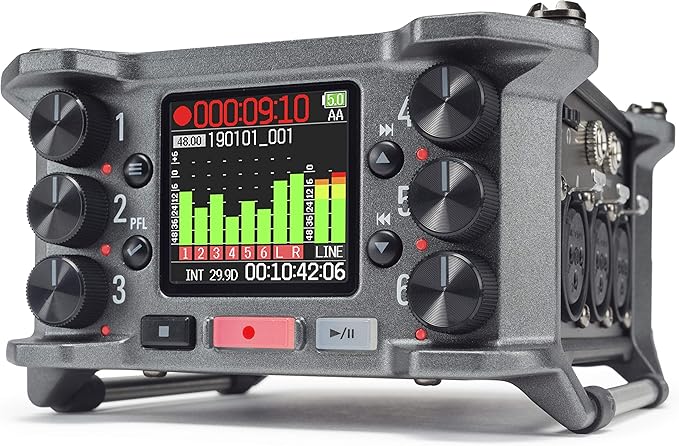
Zoom F6 The Zoom F6 is the first professional field recorder to feature both 32-bit float recording and dual AD converters. Providing an unprecedented amount of dynamic range. With 6 inputs, Zoom’s solid time code, multiple power options and wireless control, the F6 is poised to be your new secret weapon. 32 Bit Float Recording In the field, fluctuating dynamics can prove challenging. Loud sounds can cause clipping and quiet sounds can get lost in the noise. The F6 uses 32-bit float recording with dual A/D converters to capture both explosive and subtle sounds at full audio quality – without ever adjusting gain! For Those Hard to Reach Places Rugged enough to withstand the most demanding scenarios and small enough to fit into the tightest spaces, the F6 will become your go-to recorder. Checks All The Boxes Mic Preamps Equipped with six professional-grade preamps. Featuring a super-low noise floor (-127 dBu EIN), high gain (up to 75 dB), and selectable mic/line levels for each input. Precision Time Code Keep your tracks perfectly synced even when you power down for lunch. On or off, the F6’s Temperature Compensated Crystal Oscillator (TCXO) generates time code at 0.2 ppm accuracy. Advanced Look-Ahead Hybrid Limiters Overload protection is provided with the addition of the look-ahead hybrid limiters. By adding a 1-millisecond delay, the limiters “look ahead” anticipating clipping before it’s recorded. Zoom AutoMix Keep your eyes on the action by automatically adjusting the levels of your mix to reduce ambient sound. The F6 ticks all the boxes.
Zoom F6 The Zoom F6 is the first professional field recorder to feature both 32-bit float recording and dual AD converters. Providing an unprecedented amount of dynamic range. With 6 inputs, Zoom’s solid time code, multiple power options and wireless control, the F6 is poised to be your new secret weapon. 32 Bit Float Recording In the field, fluctuating dynamics can prove challenging. Loud sounds can cause clipping and quiet sounds can get lost in the noise. The F6 uses 32-bit float recording with dual A/D converters to capture both explosive and subtle sounds at full audio quality – without ever adjusting gain! For Those Hard to Reach Places Rugged enough to withstand the most demanding scenarios and small enough to fit into the tightest spaces, the F6 will become your go-to recorder. Checks All The Boxes Mic Preamps Equipped with six professional-grade preamps. Featuring a super-low noise floor (-127 dBu EIN), high gain (up to 75 dB), and selectable mic/line levels for each input. Precision Time Code Keep your tracks perfectly synced even when you power down for lunch. On or off, the F6’s Temperature Compensated Crystal Oscillator (TCXO) generates time code at 0.2 ppm accuracy. Advanced Look-Ahead Hybrid Limiters Overload protection is provided with the addition of the look-ahead hybrid limiters. By adding a 1-millisecond delay, the limiters “look ahead” anticipating clipping before it’s recorded. Zoom AutoMix Keep your eyes on the action by automatically adjusting the levels of your mix to reduce ambient sound. The F6 ticks all the boxes.
There are no live offers for Zoom F6 6-Input / 14-Track Multitrack Field Recorder right now. The all-time low we recorded was $697.22 on 5 Sept 2026. Set a price alert to hear when it's back in stock.
Prices last updated 5 Sept 2026.
Zoom F6 6-Input / 14-Track Multitrack Field Recorder
Zoom F6 The Zoom F6 is the first professional field recorder to feature both 32-bit float recording and dual AD converters. Providing an unprecedented amount of dynamic range. With 6 inputs, Zoom’s solid time code, multiple power options and wireless control, the F6 is poised to be your new secret weapon. 32 Bit Float Recording In the field, fluctuating dynamics can prove challenging. Loud sounds can cause clipping and quiet sounds can get lost in the noise. The F6 uses 32-bit float recording with dual A/D converters to capture both explosive and subtle sounds at full audio quality – without ever adjusting gain! For Those Hard to Reach Places Rugged enough to withstand the most demanding scenarios and small enough to fit into the tightest spaces, the F6 will become your go-to recorder. Checks All The Boxes Mic Preamps Equipped with six professional-grade preamps. Featuring a super-low noise floor (-127 dBu EIN), high gain (up to 75 dB), and selectable mic/line levels for each input. Precision Time Code Keep your tracks perfectly synced even when you power down for lunch. On or off, the F6’s Temperature Compensated Crystal Oscillator (TCXO) generates time code at 0.2 ppm accuracy. Advanced Look-Ahead Hybrid Limiters Overload protection is provided with the addition of the look-ahead hybrid limiters. By adding a 1-millisecond delay, the limiters “look ahead” anticipating clipping before it’s recorded. Zoom AutoMix Keep your eyes on the action by automatically adjusting the levels of your mix to reduce ambient sound. The F6 ticks all the boxes.
Zoom F6 The Zoom F6 is the first professional field recorder to feature both 32-bit float recording and dual AD converters. Providing an unprecedented amount of dynamic range. With 6 inputs, Zoom’s solid time code, multiple power options and wireless control, the F6 is poised to be your new secret weapon. 32 Bit Float Recording In the field, fluctuating dynamics can prove challenging. Loud sounds can cause clipping and quiet sounds can get lost in the noise. The F6 uses 32-bit float recording with dual A/D converters to capture both explosive and subtle sounds at full audio quality – without ever adjusting gain! For Those Hard to Reach Places Rugged enough to withstand the most demanding scenarios and small enough to fit into the tightest spaces, the F6 will become your go-to recorder. Checks All The Boxes Mic Preamps Equipped with six professional-grade preamps. Featuring a super-low noise floor (-127 dBu EIN), high gain (up to 75 dB), and selectable mic/line levels for each input. Precision Time Code Keep your tracks perfectly synced even when you power down for lunch. On or off, the F6’s Temperature Compensated Crystal Oscillator (TCXO) generates time code at 0.2 ppm accuracy. Advanced Look-Ahead Hybrid Limiters Overload protection is provided with the addition of the look-ahead hybrid limiters. By adding a 1-millisecond delay, the limiters “look ahead” anticipating clipping before it’s recorded. Zoom AutoMix Keep your eyes on the action by automatically adjusting the levels of your mix to reduce ambient sound. The F6 ticks all the boxes.
Last updated at 09/05/2026 03:59:32
ZOOM F6 Field Recorder - Professional 6 Channel 14 Track Audio Recorder with 32-Bit Float, Dual A/D Converter, Timecode - Ideal for Podcasts, Movie
Affiliate Disclosure: We may receive a small commission for purchases made through this link at no extra cost to you. This helps support our site. Thank you!
ZOOM F6 6-channel/14-track Multi-Track Field Recorder/Mixer
Zoom F6 Field Recorder
Delivery $41.67
Zoom F6 6-input 14-track Field Recorder 32-bit Float Timecode Xlr
Free delivery
Affiliate Disclosure: We may receive a small commission for purchases made through this link at no extra cost to you. This helps support our site. Thank you!
ZOOM F6 Field Mixer/Recorder, Professional Field Recording, Audio for Video, 32-Bit Float Recording,
Free delivery
Zoom F6 6-Input / 14-Track Multitrack Field Recorder
Delivery $113.44
Zoom F6 6-Input / 14-Track Multitrack Field Recorder
Zoom F6 Field Recorder
Delivery between 9–14 Sept $12
Zoom F6 Professional Field Recorder For Filmmakers & Musicians
Delivery $27.76
Wholesale Wireless control field recorder 6 XLR input mixer Pro quality preamps 32-bit float time e Zoom F6 Filmmaker & Musician,1 Piece
Delivery $15.46
originally posted on bhphotovideo.com
The Zoom F6 digital audio recorder is a solid unit for field and studio usage with a computer. It has excellent dual analog-digital converters and 32 bit float as well as 32 bit dual - 24 bit record modes which can be adjusted in most Digital audio workstations. This gives this recorder incredible dynamic range for audio. It can record at 192khz/24 bit or 32 bit float or 96khz 32 bit and 24 bit stereo mix. It also has a timecode input and I have successfully jam-synced a hardwired Tentacle Sync to keep sync with the other Tentacle sync units. Since it is so small, it is a great portable field recorder unit with the ability to be powered via three different ways! Four AA alkaline/NiCad batteries, Sony NP-F liIons (have used F770s and F970) and power banks with USB-C. ... MoreThe Zoom F6 digital audio recorder is a solid unit for field and studio usage with a computer. It has excellent dual analog-digital converters and 32 bit float as well as 32 bit dual - 24 bit record modes which can be adjusted in most Digital audio workstations. This gives this recorder incredible dynamic range for audio. It can record at 192khz/24 bit or 32 bit float or 96khz 32 bit and 24 bit stereo mix. It also has a timecode input and I have successfully jam-synced a hardwired Tentacle Sync to keep sync with the other Tentacle sync units. Since it is so small, it is a great portable field recorder unit with the ability to be powered via three different ways! Four AA alkaline/NiCad batteries, Sony NP-F liIons (have used F770s and F970) and power banks with USB-C. This is great as a portable field recorder and since it is so light and I purchased it with the Zoom PCF-F6 carry case, which it can be worn as a belt or over the shoulder. Six XLR inputs make this an excellent value as a portable digital field recorder. I have used this for narration and voice-over recordings and am very happy with the results and workflow.
originally posted on bhphotovideo.com
Like all of Zoom's products it is very simple to use. I have used two of Sennheiser's AVX-MKE2 wireless mics and a Rode NTG3 shotgun mic all connected at the same time and the F6 works great!! If I need to use more than these three mics I'll have to get some XLR adapters to take my receivers out away from the F6 otherwise they won't fit. A bit cramped as is.The reason to get the F6 is for the 32 bit floating audio recording. I recently did a shoot with the above setup. I had one sound guy to help me out on the shoot. We set the recording level about where we thought would work well. The files were set to record separate tracks. Not all mixed together. My sound guy had to run boom so it would have been impossible to run boom and mix audio at the same time. We'll ... MoreLike all of Zoom's products it is very simple to use. I have used two of Sennheiser's AVX-MKE2 wireless mics and a Rode NTG3 shotgun mic all connected at the same time and the F6 works great!! If I need to use more than these three mics I'll have to get some XLR adapters to take my receivers out away from the F6 otherwise they won't fit. A bit cramped as is.The reason to get the F6 is for the 32 bit floating audio recording. I recently did a shoot with the above setup. I had one sound guy to help me out on the shoot. We set the recording level about where we thought would work well. The files were set to record separate tracks. Not all mixed together. My sound guy had to run boom so it would have been impossible to run boom and mix audio at the same time. We'll with 32-bit floating we didn't have to worry about it.When I got back to the studio and did my edits there were a few sections of the audio recordings that had peaked when people were laughing or talked really loud. No problem. I just dropped the gain down on that section of the waveform and the audio sounds great. No distortion.Love this device! It is a real game changer!
originally posted on bhphotovideo.com
The F6 absolutely baffles me. On one hand, it's a 6-pre recorder/interface with digitally-controlled gain and (almost-)unclippable 32-bit float recording, which bizarrely gives my rack full of pro gear a run for its money with noise performance... all with the form factor of a modest sandwich. On the other, as remarked by others, even the word designed doesn't seem to jive with the user experience of actually using this thing. Did Zoom seriously not have anyone test this in real-world situations or something?Working in audio-only recording situations mostly, this took a lot of configuration to set up with logical default settings. When you get your unit, plan to spend 10-15 minutes menu-diving around to change all the things that are useless/important for your ... MoreThe F6 absolutely baffles me. On one hand, it's a 6-pre recorder/interface with digitally-controlled gain and (almost-)unclippable 32-bit float recording, which bizarrely gives my rack full of pro gear a run for its money with noise performance... all with the form factor of a modest sandwich. On the other, as remarked by others, even the word designed doesn't seem to jive with the user experience of actually using this thing. Did Zoom seriously not have anyone test this in real-world situations or something?Working in audio-only recording situations mostly, this took a lot of configuration to set up with logical default settings. When you get your unit, plan to spend 10-15 minutes menu-diving around to change all the things that are useless/important for your particular use case. Some good things to change for audio-only recording/tracking are to reduce screen brightness, turn off timecode entirely, turn off L/R record, set up Input Link and Trim Link (if you like always plugging a primary stereo pair into 1&2 or plan on using an ambisonic mic), switching battery type to match, change File Format to 'Mono/Stereo' and Mode to 24bit or 32bit. Reading the manual is a MUST; I read it before, while, and after buying it and there are still features I'm figuring out. It's not a bad manual (although obviously translated), and it actually contains a ton of information, diagrams, and specs most interface makers would refuse to even share with customers.Following the signal flow, let's start with the mic pres. There are six, all with phantom power capability (configurable between 24 and 48v). The pres on the F6 actually appear to be fixed gain; there is a 'trim' function, but according to the diagrams in the manual it's after the A/D conversion stage (i.e. after pres). I have no idea how this manages to work, and from my (limited) understanding of audio electronics this sounds like a terrible idea. However, in practice this doesn't seem to matter all that much, as the noise performance I've tested seems if anything better than my professional interface's integrated pres, but I have managed to clip the converters (an Exceeding maximum input level message pops up) by using an extraordinarily sensitive mic and an extremely loud clap. Linearity seems alright, maybe +/- 1 dB from 20Hz to 20 kHz, but I don't have the gear to test that properly. Noise performance is pretty exceptional, much better (10+ dB at matched signal levels) than equally-priced interfaces in some quick tests, though I suspect this is a side-effect of the dual-converter architecture.Zoom has both 'input linking' and 'trim linking' parameters. Input linking links the on/off and knob values for the tracks selected, while 'trim linking' matches the trim setting you set in the PFL screen (only useful in linear modes {16/24-bit}). The Input Linking has settings for mono, stereo, M/S, and ambisonic, ensuring your mics are gain-matched.Speaking of the converters, 32-bit is not at all a gimmick. I'm sure every engineer on earth worth their salt is hissing gain staging under their breath, but even the best set levels sometimes prove to be wrong and this thing can absolutely save takes that otherwise would be failures/lost, while also saving every ounce of noise performance it can at the same time. Honestly I am absolutely blown away it works at all, and would even be satisfied if it worked half as well as it does. It's so idiot-proof that I've actually loaned out the F6 (with the equally-idiot-proof NT-SF1 ambisonic mic) to performing groups so that they could record themselves at a concert when I had another engagement. It took no more than 10 minutes to explain the entire setup process and the recording quality was nearly as good as I could have done while all fitting in a remarkably small bag and requiring literally zero audio engineering experience to set-up and operate.I genuinely believe that 32-bit float recording is the future of audio recording. It is like wearing a helmet or a seatbelt: you'd be a fool not to use it if you have it. It's safer, easier, and much more flexible, like shooting in RAW on a digital camera or drawing using multiple layers on a computer. Yes, this is among the handful of first products exploring this relatively new concept, but if this is any sign, a few years from now we're going to see some of the quietest and most powerful interfaces/AD converters ever created.Sound quality is very good subjectively. It strikes me as a little less linear than maybe some higher-end converters, and I wouldn't use it to scientifically study local earthquakes, but I can honestly say I've recorded some of my absolute best recordings on it. It has no problem with any of my mics, even passive ribbons and dynamics. I've tracked everything from big bands to trios to choirs on it, surprisingly without any noticeable lack of quality compared to my usual gear.Compared to Zoom's H series, this guy consumes batteries pretty heavily, especially in 32-bit mode with phantom running on all channels. In that use case, I'd reckon 4 lithium AA's will last you about 5-6 hours (side note: don't forget to configure which type of batteries you have installed). I was looking at the prongs on the back and realized that the external battery holder sure looked familiar; turns out I had some L-type batteries lying around. With a large L-type battery, you can get some pretty insane battery life out of it, but I recommend keeping a set of Lithium AA's installed just in case you run out of juice.As an interface, the F6 works surprisingly decently. The drivers seem a little less stable than some other manufacturers and there's no desktop control software to speak of, but I had no problem using it over USB Type C on a variety of Windows devices. Even cooler, it will happily run off bus power while in Interface mode, which makes it one of the only bus-powered (or battery-powered) 6-pre USB Type C interfaces in existence, a handy capability for sessions without accessible power or again, in the rare event you run out of battery. Also, good luck finding even a 4-pre as small as this! It is important to note, however, that only up to 24-bit is allowed in Interface mode, so no 32-bit float tracking direct in the DAW... yet.What's not so good? Whoever thought the primary thing the mic knobs should control (in 16-/24-bit mode) is mix volume for the L/R mix/out, not preamp trim/gain levels. This one tripped me up for about 15 minutes before, once again, the manual came to the rescue. I contacted Zoom NA support and it sounds like enough people complained about this that they might change it in firmware. The PFL menu system gave me flashbacks to menu-driving early 90's hardware samplers (that is NOT a compliment!), but the solution to that system is not all that obvious. However, you can almost completely circumvent the menu-driving by using the control app or Zoom's fancy hardware controller if you shell out for the extra dongle. The knobs sometimes bug out and need to be moved up/down in order to start making changes to the trim again.My biggest tips: (1) get a clamp-on arm and 5/8 to 3/8 ball adapter (if necessary) so you can just clamp it on the side of your main mic stand - see photos, (2) go through the menus and PFL screens and set up all your mics, bit depth/sample-rate, and input/trim links before you even get to the session, (3) get a L-mount battery or external 5V power bank, but keep a set of AA's installed as backup, (4) turn down the LCD and LED brightness levels- they default to work in outdoor conditions, but if you're indoor you can save a lot of power, (5) take care to observe the numbers next to the inputs as I have on more than one occasion plugged a cable into input '3' intending it to go into '1', then thought the device (or mic) had malfunctioned, and (6) you can save and backup device settings (i.e. presets) to the SD card and save time manually configuring it for a regular gig/setup!Overall, I would highly recommend the F6 to anyone looking for the absolute most portable 6-pre device out there, while sacrificing very little in exchange. Yes, the menu-driving is a bit rough, yes, the UX is often inexcusable, yes, maybe there are better converters/pres out there, but once you figure out how to use the thing it will pay for itself with every take salvaged and pound of extra gear you can leave at home.
| Phantom power | +24/+48V 10mA maximum for each channel |
| Connectors | 3.5 mm stereo mini (Tip: IN, Ring: OUT) |
| Precision | ±0.2 ppm |
| Allowed input level | 0.2 – 5.0 Vpp |
| Allowed input impedance | 4.6 kΩ |

ZOOM F6 Field Recorder - Professional 6 Channel 14 Track Audio Recorder with 32-Bit Float, Dual A/D Converter, Timecode - Ideal for Podcasts, Movie
Affiliate Disclosure: We may receive a small commission for purchases made through this link at no extra cost to you. This helps support our site. Thank you!
ZOOM F6 6-channel/14-track Multi-Track Field Recorder/Mixer
Zoom F6 Field Recorder
Delivery $41.67
Zoom F6 6-input 14-track Field Recorder 32-bit Float Timecode Xlr
Free delivery
Affiliate Disclosure: We may receive a small commission for purchases made through this link at no extra cost to you. This helps support our site. Thank you!
ZOOM F6 Field Mixer/Recorder, Professional Field Recording, Audio for Video, 32-Bit Float Recording,
Free delivery
The Zoom F6 digital audio recorder is a solid unit for field and studio usage with a computer. It has excellent dual analog-digital converters and 32 bit float as well as 32 bit dual - 24 bit record modes which can be adjusted in most Digital audio workstations. This gives this recorder incredible dynamic range for audio. It can record at 192khz/24 bit or 32 bit float or 96khz 32 bit and 24 bit stereo mix. It also has a timecode input and I have successfully jam-synced a hardwired Tentacle Sync to keep sync with the other Tentacle sync units. Since it is so small, it is a great portable field recorder unit with the ability to be powered via three different ways! Four AA alkaline/NiCad batteries, Sony NP-F liIons (have used F770s and F970) and power banks with USB-C. ... MoreThe Zoom F6 digital audio recorder is a solid unit for field and studio usage with a computer. It has excellent dual analog-digital converters and 32 bit float as well as 32 bit dual - 24 bit record modes which can be adjusted in most Digital audio workstations. This gives this recorder incredible dynamic range for audio. It can record at 192khz/24 bit or 32 bit float or 96khz 32 bit and 24 bit stereo mix. It also has a timecode input and I have successfully jam-synced a hardwired Tentacle Sync to keep sync with the other Tentacle sync units. Since it is so small, it is a great portable field recorder unit with the ability to be powered via three different ways! Four AA alkaline/NiCad batteries, Sony NP-F liIons (have used F770s and F970) and power banks with USB-C. This is great as a portable field recorder and since it is so light and I purchased it with the Zoom PCF-F6 carry case, which it can be worn as a belt or over the shoulder. Six XLR inputs make this an excellent value as a portable digital field recorder. I have used this for narration and voice-over recordings and am very happy with the results and workflow.
Like all of Zoom's products it is very simple to use. I have used two of Sennheiser's AVX-MKE2 wireless mics and a Rode NTG3 shotgun mic all connected at the same time and the F6 works great!! If I need to use more than these three mics I'll have to get some XLR adapters to take my receivers out away from the F6 otherwise they won't fit. A bit cramped as is.The reason to get the F6 is for the 32 bit floating audio recording. I recently did a shoot with the above setup. I had one sound guy to help me out on the shoot. We set the recording level about where we thought would work well. The files were set to record separate tracks. Not all mixed together. My sound guy had to run boom so it would have been impossible to run boom and mix audio at the same time. We'll ... MoreLike all of Zoom's products it is very simple to use. I have used two of Sennheiser's AVX-MKE2 wireless mics and a Rode NTG3 shotgun mic all connected at the same time and the F6 works great!! If I need to use more than these three mics I'll have to get some XLR adapters to take my receivers out away from the F6 otherwise they won't fit. A bit cramped as is.The reason to get the F6 is for the 32 bit floating audio recording. I recently did a shoot with the above setup. I had one sound guy to help me out on the shoot. We set the recording level about where we thought would work well. The files were set to record separate tracks. Not all mixed together. My sound guy had to run boom so it would have been impossible to run boom and mix audio at the same time. We'll with 32-bit floating we didn't have to worry about it.When I got back to the studio and did my edits there were a few sections of the audio recordings that had peaked when people were laughing or talked really loud. No problem. I just dropped the gain down on that section of the waveform and the audio sounds great. No distortion.Love this device! It is a real game changer!
The F6 absolutely baffles me. On one hand, it's a 6-pre recorder/interface with digitally-controlled gain and (almost-)unclippable 32-bit float recording, which bizarrely gives my rack full of pro gear a run for its money with noise performance... all with the form factor of a modest sandwich. On the other, as remarked by others, even the word designed doesn't seem to jive with the user experience of actually using this thing. Did Zoom seriously not have anyone test this in real-world situations or something?Working in audio-only recording situations mostly, this took a lot of configuration to set up with logical default settings. When you get your unit, plan to spend 10-15 minutes menu-diving around to change all the things that are useless/important for your ... MoreThe F6 absolutely baffles me. On one hand, it's a 6-pre recorder/interface with digitally-controlled gain and (almost-)unclippable 32-bit float recording, which bizarrely gives my rack full of pro gear a run for its money with noise performance... all with the form factor of a modest sandwich. On the other, as remarked by others, even the word designed doesn't seem to jive with the user experience of actually using this thing. Did Zoom seriously not have anyone test this in real-world situations or something?Working in audio-only recording situations mostly, this took a lot of configuration to set up with logical default settings. When you get your unit, plan to spend 10-15 minutes menu-diving around to change all the things that are useless/important for your particular use case. Some good things to change for audio-only recording/tracking are to reduce screen brightness, turn off timecode entirely, turn off L/R record, set up Input Link and Trim Link (if you like always plugging a primary stereo pair into 1&2 or plan on using an ambisonic mic), switching battery type to match, change File Format to 'Mono/Stereo' and Mode to 24bit or 32bit. Reading the manual is a MUST; I read it before, while, and after buying it and there are still features I'm figuring out. It's not a bad manual (although obviously translated), and it actually contains a ton of information, diagrams, and specs most interface makers would refuse to even share with customers.Following the signal flow, let's start with the mic pres. There are six, all with phantom power capability (configurable between 24 and 48v). The pres on the F6 actually appear to be fixed gain; there is a 'trim' function, but according to the diagrams in the manual it's after the A/D conversion stage (i.e. after pres). I have no idea how this manages to work, and from my (limited) understanding of audio electronics this sounds like a terrible idea. However, in practice this doesn't seem to matter all that much, as the noise performance I've tested seems if anything better than my professional interface's integrated pres, but I have managed to clip the converters (an Exceeding maximum input level message pops up) by using an extraordinarily sensitive mic and an extremely loud clap. Linearity seems alright, maybe +/- 1 dB from 20Hz to 20 kHz, but I don't have the gear to test that properly. Noise performance is pretty exceptional, much better (10+ dB at matched signal levels) than equally-priced interfaces in some quick tests, though I suspect this is a side-effect of the dual-converter architecture.Zoom has both 'input linking' and 'trim linking' parameters. Input linking links the on/off and knob values for the tracks selected, while 'trim linking' matches the trim setting you set in the PFL screen (only useful in linear modes {16/24-bit}). The Input Linking has settings for mono, stereo, M/S, and ambisonic, ensuring your mics are gain-matched.Speaking of the converters, 32-bit is not at all a gimmick. I'm sure every engineer on earth worth their salt is hissing gain staging under their breath, but even the best set levels sometimes prove to be wrong and this thing can absolutely save takes that otherwise would be failures/lost, while also saving every ounce of noise performance it can at the same time. Honestly I am absolutely blown away it works at all, and would even be satisfied if it worked half as well as it does. It's so idiot-proof that I've actually loaned out the F6 (with the equally-idiot-proof NT-SF1 ambisonic mic) to performing groups so that they could record themselves at a concert when I had another engagement. It took no more than 10 minutes to explain the entire setup process and the recording quality was nearly as good as I could have done while all fitting in a remarkably small bag and requiring literally zero audio engineering experience to set-up and operate.I genuinely believe that 32-bit float recording is the future of audio recording. It is like wearing a helmet or a seatbelt: you'd be a fool not to use it if you have it. It's safer, easier, and much more flexible, like shooting in RAW on a digital camera or drawing using multiple layers on a computer. Yes, this is among the handful of first products exploring this relatively new concept, but if this is any sign, a few years from now we're going to see some of the quietest and most powerful interfaces/AD converters ever created.Sound quality is very good subjectively. It strikes me as a little less linear than maybe some higher-end converters, and I wouldn't use it to scientifically study local earthquakes, but I can honestly say I've recorded some of my absolute best recordings on it. It has no problem with any of my mics, even passive ribbons and dynamics. I've tracked everything from big bands to trios to choirs on it, surprisingly without any noticeable lack of quality compared to my usual gear.Compared to Zoom's H series, this guy consumes batteries pretty heavily, especially in 32-bit mode with phantom running on all channels. In that use case, I'd reckon 4 lithium AA's will last you about 5-6 hours (side note: don't forget to configure which type of batteries you have installed). I was looking at the prongs on the back and realized that the external battery holder sure looked familiar; turns out I had some L-type batteries lying around. With a large L-type battery, you can get some pretty insane battery life out of it, but I recommend keeping a set of Lithium AA's installed just in case you run out of juice.As an interface, the F6 works surprisingly decently. The drivers seem a little less stable than some other manufacturers and there's no desktop control software to speak of, but I had no problem using it over USB Type C on a variety of Windows devices. Even cooler, it will happily run off bus power while in Interface mode, which makes it one of the only bus-powered (or battery-powered) 6-pre USB Type C interfaces in existence, a handy capability for sessions without accessible power or again, in the rare event you run out of battery. Also, good luck finding even a 4-pre as small as this! It is important to note, however, that only up to 24-bit is allowed in Interface mode, so no 32-bit float tracking direct in the DAW... yet.What's not so good? Whoever thought the primary thing the mic knobs should control (in 16-/24-bit mode) is mix volume for the L/R mix/out, not preamp trim/gain levels. This one tripped me up for about 15 minutes before, once again, the manual came to the rescue. I contacted Zoom NA support and it sounds like enough people complained about this that they might change it in firmware. The PFL menu system gave me flashbacks to menu-driving early 90's hardware samplers (that is NOT a compliment!), but the solution to that system is not all that obvious. However, you can almost completely circumvent the menu-driving by using the control app or Zoom's fancy hardware controller if you shell out for the extra dongle. The knobs sometimes bug out and need to be moved up/down in order to start making changes to the trim again.My biggest tips: (1) get a clamp-on arm and 5/8 to 3/8 ball adapter (if necessary) so you can just clamp it on the side of your main mic stand - see photos, (2) go through the menus and PFL screens and set up all your mics, bit depth/sample-rate, and input/trim links before you even get to the session, (3) get a L-mount battery or external 5V power bank, but keep a set of AA's installed as backup, (4) turn down the LCD and LED brightness levels- they default to work in outdoor conditions, but if you're indoor you can save a lot of power, (5) take care to observe the numbers next to the inputs as I have on more than one occasion plugged a cable into input '3' intending it to go into '1', then thought the device (or mic) had malfunctioned, and (6) you can save and backup device settings (i.e. presets) to the SD card and save time manually configuring it for a regular gig/setup!Overall, I would highly recommend the F6 to anyone looking for the absolute most portable 6-pre device out there, while sacrificing very little in exchange. Yes, the menu-driving is a bit rough, yes, the UX is often inexcusable, yes, maybe there are better converters/pres out there, but once you figure out how to use the thing it will pay for itself with every take salvaged and pound of extra gear you can leave at home.
The user interface is like something from 40 years ago before there were touch screens and emphasis on good design. Some of this can be avoided by using an iPhone and buying the optional Sound Devices Bluetooth adapter but it is a half measure.Having use the Sound Devices Mixpre-3 II recorder the Zoom F6 seems primative by comparison. The F6 does provide additional inputs but it still requires an external power source or L type batteries for long recording sessions.When using the L type batteries they are mounted directly to the rear of the F6 the NP-F battery will block access to the SD card. Similar problem with the MixPre-3 but this recorder can be operated without AA or the L batteries and using only a USB-C power source.The mechanical build of the F6 is ... MoreThe user interface is like something from 40 years ago before there were touch screens and emphasis on good design. Some of this can be avoided by using an iPhone and buying the optional Sound Devices Bluetooth adapter but it is a half measure.Having use the Sound Devices Mixpre-3 II recorder the Zoom F6 seems primative by comparison. The F6 does provide additional inputs but it still requires an external power source or L type batteries for long recording sessions.When using the L type batteries they are mounted directly to the rear of the F6 the NP-F battery will block access to the SD card. Similar problem with the MixPre-3 but this recorder can be operated without AA or the L batteries and using only a USB-C power source.The mechanical build of the F6 is superior to that of the Mixpre-3 II but good hardware and no touch sensitive screen as with the Sound Devices recorder negates that to a considerable degree.After using both recorders I have decided to go with the Mixpre-3 and external USB-C power banks for my own projects.
I've had a number of recorders from various companies (TASCAM, ZOOM H-series, ROLAND) and currently this is one of the best made, offering great sound quality equipment in this price range and even higher (e.g. strong competitor but troublesome... SD MixPre3 MK2!) that I've had. Superb for recording ambient sounds as well as for video recording.This is a completely different quality device from the well-known and popular H-series recorders and there is nothing to compare here.Moreover:- Recording in 32bit gives you amazing control over the sound,- Very good microphone preamps, they have real low noise, when working with good microphones you can make recordings of silence.... :)- The F6 runs for a very long time on good quality AA batteries with 48V phantom ... MoreI've had a number of recorders from various companies (TASCAM, ZOOM H-series, ROLAND) and currently this is one of the best made, offering great sound quality equipment in this price range and even higher (e.g. strong competitor but troublesome... SD MixPre3 MK2!) that I've had. Superb for recording ambient sounds as well as for video recording.This is a completely different quality device from the well-known and popular H-series recorders and there is nothing to compare here.Moreover:- Recording in 32bit gives you amazing control over the sound,- Very good microphone preamps, they have real low noise, when working with good microphones you can make recordings of silence.... :)- The F6 runs for a very long time on good quality AA batteries with 48V phantom power on, the ability to connect a SONY NP-series battery is a great thing,- The display is very clear, but the recording time information could be better shown,- A range of convenient cases and bags for the F6 are available,- TC code operation, super useful for video recording,- Works very well as a USB audio interface with iPad/iPhone,- Works very well with PC as a 4-track audio interface.- The case is plastic and picks up interference from a GSM phone close by, other than that there are no interference problems,I sincerely recommend Narada for audio recording in the field.Translated with www.DeepL.com/Translator (free version)
Im new into videography. At first I purchased a Rode Videomic Pro shotgun mic, which worked fairly well for my needs. The trouble was the audio was not as clear as I wanted, but most of that was my fault in not knowing the best way to use it meaning placement. Then I ordered a Zoom H5 that was better quality audio, but not crispy enough. I could do more post work to correct but I looked for an easier solution. I found my answer in the Zoom F6, which was the next step up. It is fantastic especially with the 32 bit float. I am extremely happy with this audio recorder.
I'm using this recorder as part of a single-shooter video rig shooting gymnastics events for a YouTube channel called Grips. Chalk. Flip.This recorder works well with my setup, which includes a Nikon Z6 connected via HDMI to a BlackMagic Video Assist 12g shooting in 10-bit N-Log in ProRes HQ. I'm using 5-6 of the inputs on the Zoom, feeding the mix to the Z6 via one stereo channel and a free run clock timecode from the Zoom F6 to the other stereo channel. Both audio channels are then fed to the BMVA via HDMI. Feeding through the camera rather than direct to the BMVA helps with the HDMI latency from the Z6 by keeping the audio and video in sync. I sync my dailies using Tentacle Sync Studio, which is quick and exports easily into Final Cut Pro X.The 32-bit float ... MoreI'm using this recorder as part of a single-shooter video rig shooting gymnastics events for a YouTube channel called Grips. Chalk. Flip.This recorder works well with my setup, which includes a Nikon Z6 connected via HDMI to a BlackMagic Video Assist 12g shooting in 10-bit N-Log in ProRes HQ. I'm using 5-6 of the inputs on the Zoom, feeding the mix to the Z6 via one stereo channel and a free run clock timecode from the Zoom F6 to the other stereo channel. Both audio channels are then fed to the BMVA via HDMI. Feeding through the camera rather than direct to the BMVA helps with the HDMI latency from the Z6 by keeping the audio and video in sync. I sync my dailies using Tentacle Sync Studio, which is quick and exports easily into Final Cut Pro X.The 32-bit float is great, too, because in this setup, I can't pay much attention to the audio levels apart from what I hear in the mix, so I don't have to worry about clipping as I can fix it later.
This a great recorder for high quality sound (32bit float), and a God send for one-man bands. Once you set up each channel the way you want them, you press "rec" and forget about it. With 6 inputs, it is quite small and portable.with a reassuring feel of good construction. Knobs and buttons are small and packed together but this is what makes it so portable. It is not cheap but still a little over $100 x input. Highly recommended.
Everything about this little machine is very good, indeed. The fact that it is small by itself presents minor challenges, such as being able to press the menu buttons etc. since they are so closely spaced. To save space, line out, timecode and headphone outputs are tiny 3.5 mm instead of a hefty XLR, but no bid deal. My only real negative is that the headphone volume switch also has other functions if it is pressed, which is so easy to do accidentally. Though no fault of the machine itself is the instruction manual. Very very few manufacturers give you a real one, expecting you to go online. Even an included disc would be appreciated. It does come with a quick guide, covering all the functions. Again, Zoom being no exception, some functions are mentioned but not ... MoreEverything about this little machine is very good, indeed. The fact that it is small by itself presents minor challenges, such as being able to press the menu buttons etc. since they are so closely spaced. To save space, line out, timecode and headphone outputs are tiny 3.5 mm instead of a hefty XLR, but no bid deal. My only real negative is that the headphone volume switch also has other functions if it is pressed, which is so easy to do accidentally. Though no fault of the machine itself is the instruction manual. Very very few manufacturers give you a real one, expecting you to go online. Even an included disc would be appreciated. It does come with a quick guide, covering all the functions. Again, Zoom being no exception, some functions are mentioned but not given detail as to actual use. Case in point: linking. Likewise, it would be nice to expand on any accessories and how to use them, beyond how to find the features in a menu. If people understood what's available and how to fill their need - and how to use it - I'm sure customers (like me!) would be more likely to be happier, use the features more, and buy more accessories. Looking at the reviews, even the bag/case made for the F6 isn't as well thought out, including those from third party vendors. This may or may not be an issue for you. Bottom line, accessories are often afterthoughts, so look critically before you buy, because features and specs on paper don't mean much if you find it difficult to actually use your equipment. For it's price, it's so hard to beat - I bought this instead of other brands... with no regrets!
I used this on a professional job recently where the audio skipped ahead during a recording making a portion of an interview with a celebrity client unusable.Zoom knew this was an issue, but did not notify its user base adequately. Supposedly, it has to do with recordings done using 32 bit and 24 but at the same time. A firmware patch supposedly fixed it...but how do i know that?Fortunately, I'm also doing post on this, job and was able to cut around it and save face - but in two sections of the interview this problem occurred. So it's literally a crap shoot on whether you're going to hear your recording or not.Epic failure on Zoom's part. I developed trust for the brand based on prior reliable use of the H6 line...this caused all that goodwill to ... MoreI used this on a professional job recently where the audio skipped ahead during a recording making a portion of an interview with a celebrity client unusable.Zoom knew this was an issue, but did not notify its user base adequately. Supposedly, it has to do with recordings done using 32 bit and 24 but at the same time. A firmware patch supposedly fixed it...but how do i know that?Fortunately, I'm also doing post on this, job and was able to cut around it and save face - but in two sections of the interview this problem occurred. So it's literally a crap shoot on whether you're going to hear your recording or not.Epic failure on Zoom's part. I developed trust for the brand based on prior reliable use of the H6 line...this caused all that goodwill to evaporate.If using on a shoot that you're relying on this recorder - buyer BEWARE.Do a google search on WARNING: Audio jumps in Zoom F6 recording and you'll see another user illustrating the exact problem i had.
| Phantom power | +24/+48V 10mA maximum for each channel |
| Connectors | 3.5 mm stereo mini (Tip: IN, Ring: OUT) |
| Precision | ±0.2 ppm |
| Allowed input level | 0.2 – 5.0 Vpp |
| Allowed input impedance | 4.6 kΩ |


